Trust Events
Doors Open for Churches
EAST HANTS
September 14-15, 2019
[ SELECT ANOTHER LOCATION ]
HOURS:
Doors will be open Saturdays 10am - 4pm and on Sunday afternoon from noon – 4pm unless otherwise noted.
MAPS:
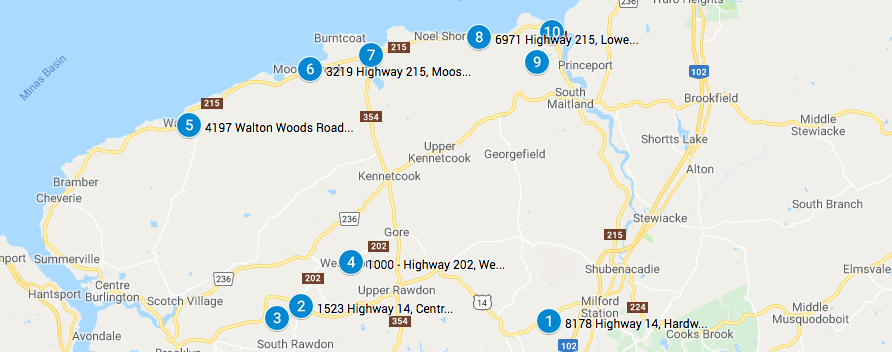
Some areas do not have adequate internet access to provide you with access to this website. You may print out a copy of the GoogleMap for yourself, take note of the addresses and directions, or use GPS.
ACC indicates Wheelchair accessibility;
WR indicates Washroom availability
| EAST HANTS COUNTY |
 |
| |
1 |
HARDWOOD LANDS PRESBYTERIAN CHURCH
8178 Highway 14, Hardwood Lands >  |
ACC |
WR |
| |
Doors Open: Saturday 10am-4pm
In 1924, the Federal Act of Church Union stated that the Presbyterian, Methodist, and Congregational Churches would unite under the name "United Church of Canada". Presbyterians decided to worship separately. At the same time, an abandoned Congregational Church in South Maitland was for sale. The building was purchased and dismantled; it was then carefully rebuilt in its present location. The original doors, pulpit, bell, and organ are still part of the building. Two of the original windows are in use. |
√ |
no |
| |
|
|
|
2 |
ST PAUL'S ANGLICAN CHURCH
1523 Highway 14, Centre Rawdon > |
ACC |
WR |
| |
Doors Open: Saturday 10am-4pm, Sunday 2-4pm
The current St. Paul's Church was built in 1845, replacing the original church building built in 1794. The church and surrounding burial ground were consecrated in 1847. St. Paul's is the "Parish Church" for the Anglican Parish of Rawdon, which extends from Nine Mile River to Stanley, including the Rawdons, Gore, and Clarksville. The architectural style of St. Paul's Church is, for the most part, Gothic Revival. The windows are Gothic, and the squared molding over the front entrance reflects the English Perpendicular Gothic influence. Inside, classical influences are carried over into the chancel corners, the back gallery and the pulpit. The straight-backed pews originally were boxed; the interior doors are Christian in style.
|
√ |
no |
| |
|
|
|
3 |
RAWDON HILLS UNITED CHURCH
9 Old Trunk 14 Road, Upper Rawdon > |
ACC |
WR |
| |
The first settlers in the Rawdon area were mostly from the Methodist Church; they arrived after the Revolutionary War as early as 1784. In 1833, Andrew and Nancy Pearson sold an acre of land for a Methodist Church and Cemetery. In 1835, the first church was a crude building, followed by a second construction in 1866. The church that was built then still forms the main part of the church today. In 1964, the Edward Bond family donated land adjacent to the original acre of land, which allowed for a basement furnace and extensions of the main building to allow for additional rooms and choir loft.
|
√ |
no |
| |
|
|
|
4 |
WEST GORE DISCIPLE CHURCH
1000 Highway 202, West Gore > |
ACC |
WR |
| |
Doors Open: Saturday 10am-4pm, Sunday 1-5pm
From 1832, about 20 families met in homes in the West Gore area, eventually becoming one of Nova Scotia's congregations of the Christian Church (Disciples). The West Gore Disciple Church was built in 1885/86 on its present site, replacing an earlier meeting house that stood across the road and was removed in order to expand the cemetery. In 1970, modernization resulted in the building being raised, allowing for a basement level with a fellowship space, kitchen, bathroom, and external entrance, and later, a stairwell from the sanctuary to the lower level with a chair-lift. Four of the eight original windows have been filled with stained glass memorials, but it is the wish of the present congregation that the other four remain plain glass. Until the 1960s, this was an "a capella church", no accompanying instrument being allowed.
|
√ |
no |
| |
|
|
|
5 |
GRACE UNITED CHURCH
4197 Walton Woods Road, Walton > |
ACC |
WR |
| |
Established sometime before 1860, Walton's present-day United Church was originally Methodist, and by 1877 was referred to as "The Walton Mission." The construction of a new building began in the 1890s and was dedicated June 6, 1895. Church union in 1925 saw it renamed the United Church, and in 1962, the congregation added the name "Grace" to the church title to honour the memory of Miss Grace Morris, a faithful supporter. The church features lovely stained glass windows sponsored by and dedicated to church members.
|
√ |
√ |
| |
|
|
|
6
|
MOOSE BROOK CHAPEL
3219 Highway 215, Moose Brook >
|
ACC |
WR |
| |
*Notice - Unfortunately Moose Brook Chapel is unable to participate this weekend.
Moose Brook Chapel was originally constructed as the Moose Brook Congregational Church in 1880; however, the Congregationalists were unable to finish their church. The unfinished building was sold to the local Presbyterians, who completed the building and opened the church in 1884 as the Moose Brook Presbyterian Church. Like many Presbyterian churches, Moose Brook Presbyterian Church entered church union in 1925, becoming Moose Brook United Church. In 1967, amalgamating with Noel Pastoral Charge, the church was closed, and the congregation began worshiping at Noel United Church. The church remained vacant until 1970, when it was re-purposed as the Moose Brook Chapel, which it remains today. |
some |
some |
| |
|
|
|
7 |
NOEL UNITED CHURCH
4588 Highway 215, Noel > |
ACC |
WR |
| |
During a time of economic prosperity and amidst significant social change, Noel Presbyterian Church was erected in 1874, replacing the first, more modest, Presbyterian church, which had been constructed decades earlier in the far east of present-day Noel. In 1925, Noel Presbyterian Church united with the Methodist Church and the Congregational Union of Canada to form the United Church of Canada. Noel Presbyterian Church henceforth became known as Noel United Church. By 1967, declining rural populations and dwindling church attendance resulted in amalgamation of the five churches of the Noel Pastoral Charge, with Noel United Church serving all congregations. Celebrating 145 years, the church building remains an active focal point within the community and has seen many renovations and modernizations, including the adornment of modern stained-glass windows within the sanctuary.
|
no |
no |
| |
|
|
|
8 |
LOWER SELMA MUSEUM & HERITAGE CEMETERY (former Lower Selma Presbyterian/United Church)
6971 Highway 215, Lower Selma > |
ACC |
WR |
| |
Built in 1865 as a Presbyterian Church, the present-day Lower Selma Museum was also at one time a United Church of Canada, until amalgamation of the congregations of the Noel Pastoral Charge rendered the building surplus. In 1981, the East Hants Historical Society began its operation of a museum on the premises. A striking feature of the building interior is its "Painted Walls." Done in 1881 by itinerant painter Lewis Bailey, the plaster walls and ceilings feature trompe l'oeil design and faux marbling.
|
no |
√ |
| |
|
|
|
9 |
HOLY TRINITY ANGLICAN CHURCH
22 Cedar Road, Maitland, Hants County > |
ACC |
WR |
| |
Doors Open: Saturday 10am-4pm, Sunday 1-4pm
Refreshments at nearby Church Hall
This church was built in 1864 to replace an earlier one, also Anglican, that had been on the same site. It is an example of Gothic Revival architecture built by Maitland carpenter Thomas Dickie, who also built the house at 40 Cedar Road. The church has a steeply pitched roof with a bell cote. Features include: an interior built like an upside down ship's hull with large beams, a large stained glass window over the altar, and lancet windows on the sides.
|
√ |
√ |
| |
|
|
|
10 |
HIGH TIDES ARTS & COMMUNITY CENTRE (former St. David's Presbyterian/United Church)
11 Church Hill, Maitland > |
ACC |
WR |
| |
Doors Open: Saturday & Sunday 10am-4pm
Although Maitland's first Presbyterian minister, Rev. Alexander Dick, was the first ordained by a permanently constituted Presbytery in Canada, and his ordination in Maitland in 1803 marked the founding of the Maitland Presbyterian congregation, he died before he could conduct a service in St. David's. Built in 1858 in the Classical Revival style, it later became a United Church of Canada. Materials and labour for the construction were provided by volunteers. An interesting feature is a small box with a glass door attached to the exterior of the church and holding the church key.When there was a fire in the area, someone would break the glass to open the church to ring the bell to alert the community and the Fire Brigade. Today, the building and nearby hall have been acquired by the CHArt Society ( Culture, Heritage and Arts) and repurposed as a Performing Arts Centre. |
√ |
√ |
| |
|
|
|
|
The HTNS Places of Worship Committee is dedicated to cataloguing our religious buildings, promoting policies to protect them, and publicizing their architectural importance to Canada.


|