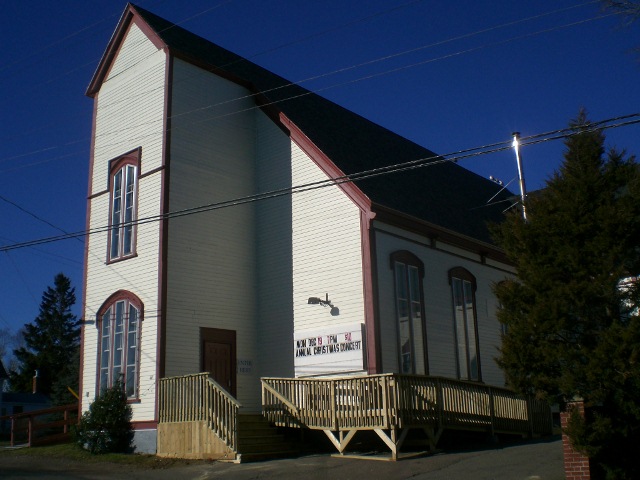
Heritage Trust sponsors monthly illustrated lectures related to heritage buildings. Talks may focus on architectural history, the events and persons associated with a building or place, or other building-related topics such as restoration. Read more to find out what is coming up or call us at 423-4807.
Trust Events
Illustrated Public Lecture Series
Our lectures now take the form of an online video presentation released on the third Thursday of each month at 7:30PM. The lecture series runs annually from September - November and January - May.
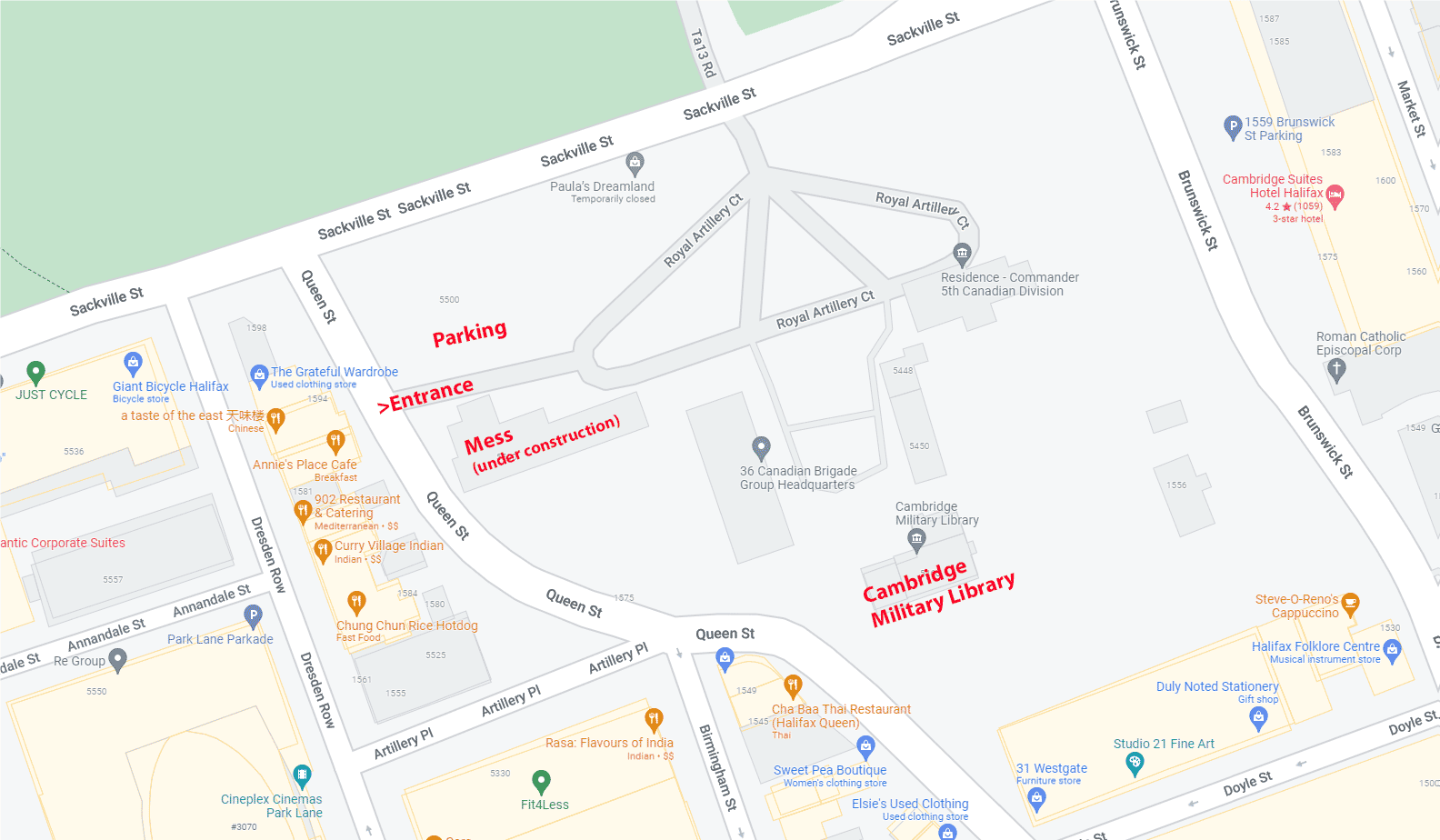
HTNS Lecture &Annual General MeetingDate: Thursday June 23, 22, 7-9 PM Join us on June 23, 2022 for the Heritage Trust of Nova Scotia’s Lecture & Annual General Meeting. Attend in person at the Cambridge Military Library, Artillery Park or online via Zoom.
A lecture by Jane Henson on the restoration of Fairhaven, her mid-18th century Cape Cod style home in Riverport, will begin promptly at 7PM followed by the AGM at 8PM.
We look forward to seeing you!
DIRECTIONS:DIRECTIONS TO ARTILLERY PARK MESS
|
|||||
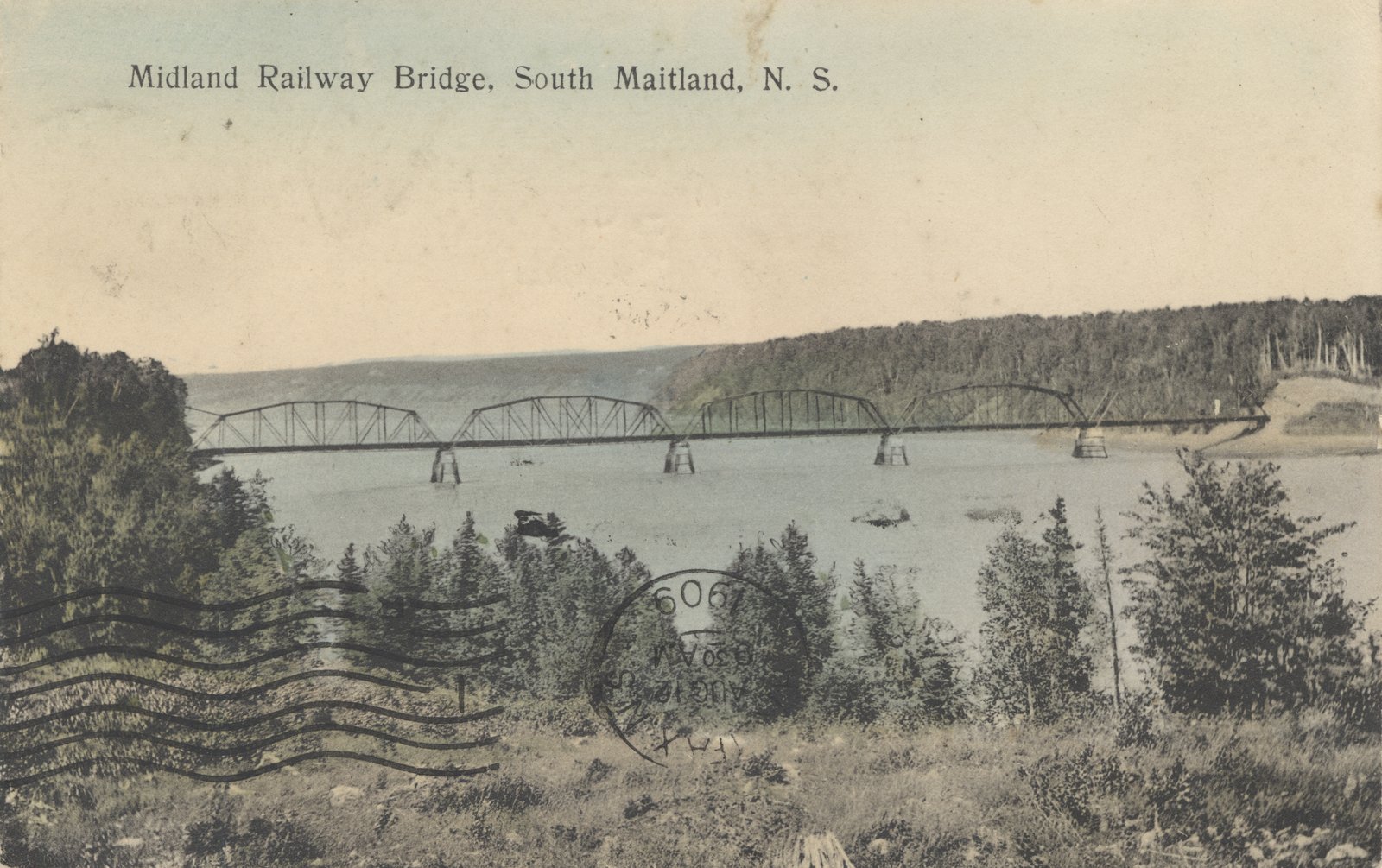
HTNS Illustrated Public Lecture SeriesBridging the Bay: South Maitland Railway Bridge Accidents (1899)Date: Virtual Public talk (on Zoom) Thursday 19 May at 7:30 pm
Holly Hanes has long had a fascination with railways, their history and the structures associated with them. One of those structures was the South Maitland railway bridge, constructed across Nova Scotia’s largest river. The Shubenacadie River has twice-daily, high velocity, reversing flows, and tides of up to 45 feet. The remains of the railway bridge at South Maitland, eroded by the currents, stand as a testament to the challenges of such a project. It is not surprising that the bridge construction entailed loss of life. Many factors could have entered into the decision about where to site the bridge; Holly will discuss the decision making that led to the chosen location. She will also describe the construction period (1898-1901) and the legacy of the bridge project for the community today. Holly Hanes completed her MA (History) in 2020 at Dalhousie. Her thesis topic was “Much More than Chocolate: a mosaic of Moir’s advertising identity 1830-2007.” Following her early interest in heritage – she first competed in a Heritage Fair in grade four – she spent five summers working for the East Hants Historical Society, most recently conducting an inventory of cemeteries in East Hants. Holly is currently an at-large Board member of Heritage Trust and a member of the Program Committee.
|
|||||
HTNS Illustrated Public Lecture SeriesBefore It's Gone HalifaxDate: Virtual Public talk Thursday 21 April at 7:30 pm
Social media has become an important tool in daily life. It is part of the way we access and share news, influence or be influenced by others. It can also be a shared space for creating a public record. Hayley Frail, an undergraduate student studying European Studies/Civilization at the University of Kings College, looks at the current pressure on older buildings and neighbourhoods in Halifax, exploring how social media could be used to mitigate the effects of this development pressure. This lecture originally aired as part of the HTNS Illustrated Public Lecture Series on April 21st, 2022.
|
|||||
HTNS Illustrated Public Lecture SeriesAncestralHomes Network – researching and recording your family’s ancestral homesDate: Thursday 17 February at 7:30 pm Nancy Donnelly is the CEO of AncestralHomes Network, a platform which allows users to search for and add information about ancestral homes anywhere in the world. The site was created to fill the ‘void’ in the genealogical platforms that presently exist. It is easier to find a grave, a marriage certificate, a birth notice, etc. than to find information about the house that our ancestors lived in. This is particularly true for homes that have disappeared or are not of great historical significance. AncestralHomes’ website allows users to add and save the information they have about their family’s history so the next generation doesn’t have to search through complicated documents again! Join us to find out more about this free service.
|
|||||
HTNS Illustrated Public Lecture SeriesHistory and Historic Places at Pier 21Date: Thursday 20 January 2022 at 7:30 pm Pier 21 is associated in the public’s mind with immigration but it was only finished in the late 1920s. What was the arrival experience like before that time? What places were destroyed to make way for the Ocean Terminals? What structures made up the historic, working immigration site, and what remains or survives there? Join us as Steven Schwinghamer describes the history of the Pier 21 site. Steven Schwinghamer is a historian working at the Canadian Museum of Immigration at Pier 21. Among his interests is the history of the buildings serving immigrants arriving in Halifax.
|
|||||
HTNS Illustrated Public Lecture SeriesTo the place of beginning: how the North End houses of Henry J Harris came to beDate: Thursday, November 18 at 7:30pm
Mimi Fautley began researching her own home and then seven neighbouring, contiguous houses built by Henry J Harris on Maynard Street in the North End of Halifax. For this talk, she has expanded the geographical reach beyond the original eight houses. Her presentation will look at material and intangible histories of the houses, and some of their owners and occupants, as a way of showing how "ordinary" houses can play a surprisingly consequential role in our individual and collective heritage.
|
|||||
HTNS Illustrated Public Lecture SeriesThe Myers Family Homestead: a love story for the generationsPlace: online presentation You are invited to a virtual visit with the owner of a municipally-designated home on the Eastern Shore. Dr Brenda Hattie-Longmire will be our speaker, sharing the story of her family’s 1884 home. She is the great granddaughter of James W Myers and his wife, Eliza, for whom it was built. The Myers name is well-known in the area and will be recognized by those familiar with the Fisherman’s Life Museum in Jeddore Oyster Ponds. The museum was the home of Ervin Myers, James W’s brother, and interprets the life of an inshore fisherman and his family.
|
|||||
HTNS Illustrated Public Lecture SeriesInsuring Older & Heritage BuildingsRelease Date: Thursday, Mar 23, 2021 at 7:30PM
Guest speakers Amanda Dean of the Insurance Bureau of Canada and Aneill MacCaull of the Insurance Brokers Association of Nova Scotia discuss the particulars of insuring older and heritage-designated buildings. Insuring Old Homes in Nova Scotia Informational Brochure: https://www.gov.mb.ca/chc/pdf/heritage_home-ns.pdf Insuring Heritage Properties (Insurance Bureau of Canada): https://www.ibc.ca/on/home/heritage-properties
|
|||||
HTNS Illustrated Public Lecture SeriesThe Stones of Spring Garden Road – a walking tourRelease Date: Thursday, November 19, 2020 at 7:30PM
Geologist Dr. Howard Donohoe will guide us along Spring Garden Road, talking about local building stone, the quarry location, building styles, and important geological history from the building stones. All of the ironstones originated at the Dalhousie quarries while the granites are not only extraordinary in their diversity but also in their location of origin. Only a few locations have granite from the Purcell’s Cove quarries.
|
|||||
HTNS Illustrated Public Lecture SeriesDowntown Dartmouth Heritage Conservation DistrictOctober’s talk is our first to be delivered on-line to virtual attendees. Release Date: Thursday, October 29, 2020 at 7:30PM
David Jones, HTNS Board member, speaks about the area of Downtown Dartmouth that has been identified for future designation as a heritage conservation district. As David makes clear, there is as much to recognize and protect below ground as there is above ground.
|
|||||
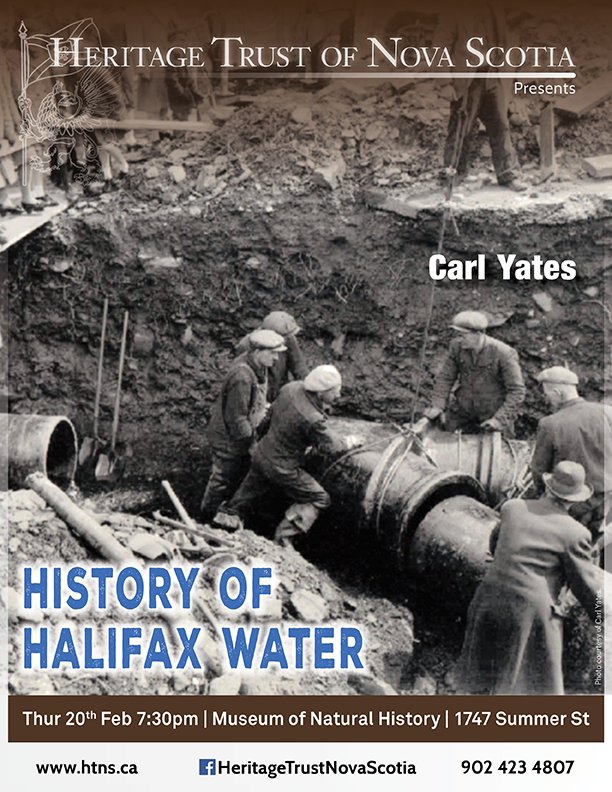
HTNS Illustrated Public Lecture SeriesThe History of Halifax WaterDate: Thursday, February 20, 2020 at 7:30 pm “Those largely unseen engineering marvels, and the geographical realities underlying them, have influenced individual building design and the direction of urban development from Halifax’s earliest days, and they continue to do so, “ says Michèle Raymond, Heritage Trust of Nova Scotia’s Program Chair. Carl Yates obtained a Bachelor of Engineering from Memorial and a Master of Applied Science from the Technical University of Nova Scotia [now Dalhousie University] in 1992. He previously served as Director of the Water Research Foundation [WRF] with roles as Chair of the Research Advisory Council and Focus Area Council, and Chair of the National Research Council InfraGuide Potable Water Committee. He currently serves as the Chair of the Canadian Water Network, Board Member of the Alliance for Water Efficiency, and Director of Operators without Borders. Mr. Yates received the AWWA George Warren Fuller Award in 2010 for exemplary leadership and contributions to the waterworks industry. In 2019, he was awarded the NS Engineers Sexton Gold Medal for exceptional achievements in engineering practice and contributions to society.
|
|||||
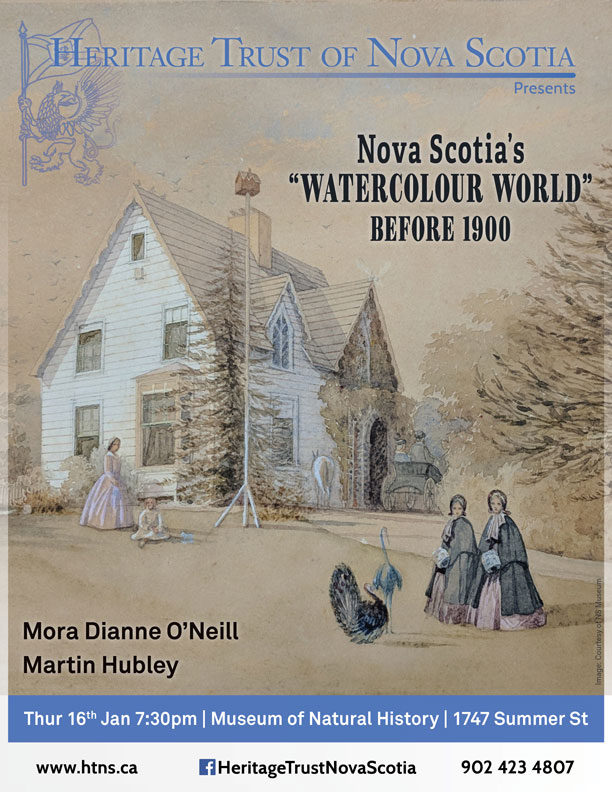
HTNS Illustrated Public Lecture SeriesNova Scotia’s “Watercolour World” before 1900Date: Thursday, January 16 at 7:30 pm
This talk will outline the UK-based Watercolour World digital public history project (watercolourworld.org) and why we hope Nova Scotian institutions and collectors will contribute to it. Contrasting the UK experience with a brief history of the art form in Nova Scotia, it will demonstrate how differences in chronology and in collecting by institutions in Canada made for very different perspectives on collections here. Finally, it will provide a brief overview of some of the more important artists and works in both the collections of the Art Gallery of Nova Scotia and the Nova Scotia Museum, focused on landscape views, that we hope will be part of the larger Watercolour World project and in future available online for all to enjoy. Mora Dianne O’Neill retired last year as Associate Curator, Historical Prints and Drawings, for the Art Gallery of Nova Scotia. The forty-three exhibitions she prepared there for the print salon were a splendid introduction to the world of watercolours and prints that have attracted the attention of the British Foundation. Martin Hubley is curator of the cultural history collection of the Nova Scotia Museum, which includes almost 400 watercolours, the majority by John Elliott Woolford and Maria Morris Miller. His research interests are focused largely on Nova Scotia, identity, empire and the Atlantic world during the eighteenth and nineteenth centuries.
|
|||||
HTNS Illustrated Public Lecture SeriesFort Massey Cemetery: a garrison graveyard and the influence of the Commonwealth War Graves CommissionDate: Thursday, November 21 at 7:30 pm Speaker: Don Chard, PhD 
Photo Credit - HMHPS
|
|||||
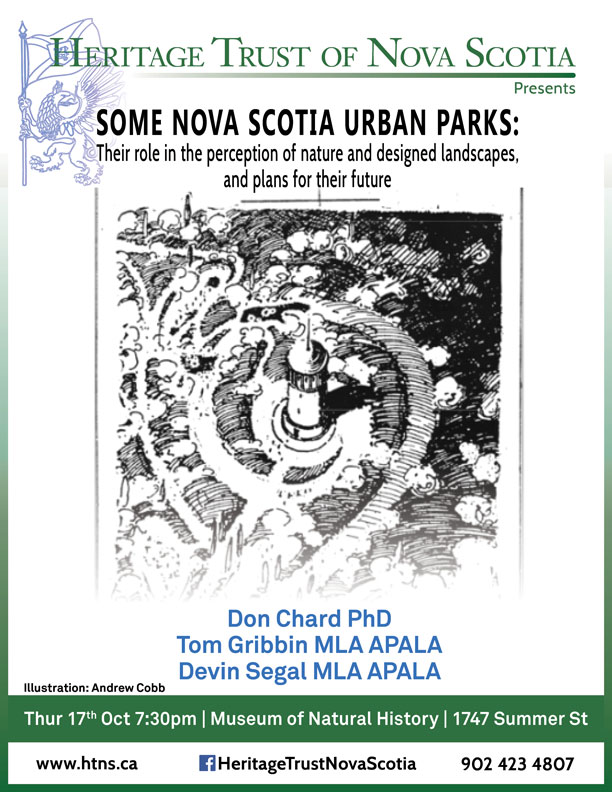
HTNS Illustrated Public Lecture SeriesSOME NOVA SCOTIA URBAN PARKS: Their role in the perception of nature and designed landscapes, and plans for their futureDate: Thursday 17 October at 7:30 pm Speakers: Don Chard, Tom Gribbin, and Devin Segal
Don Chard PhD is an historian and former planner with Parks Canada
|
|||||
Doors Open for ChurchesGuided Tours of Places of Worship
|
|||||
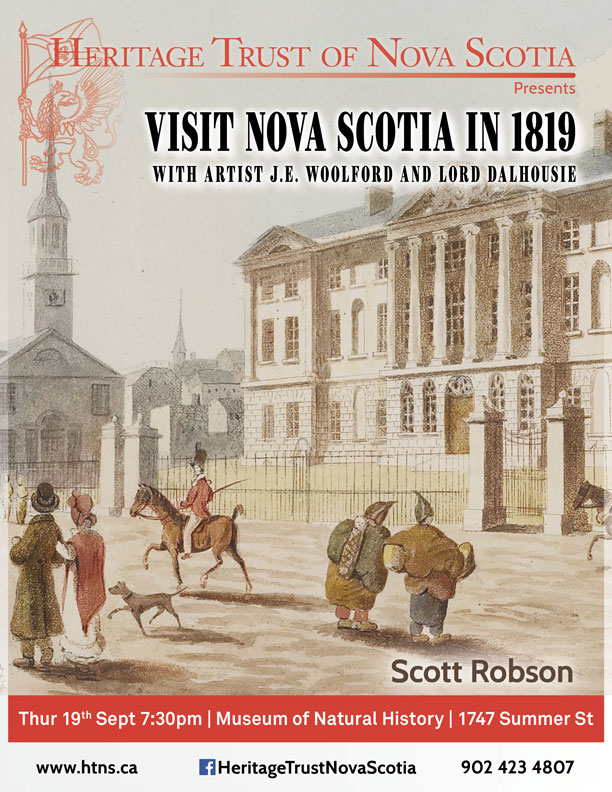
HTNS Illustrated Public Lecture SeriesNova Scotia in 1819: Pictures by J.E. Woolford, words by Lord DalhousieDate: Thursday 19 September at 7:30 pm To put in a context: Join Scott Robson for a tour of our province 200 years ago to see what Lord Dalhousie saw in his travels.
Scott Robson is the former Curator of the History Collection at the NS Museum. He first ‘met’ Lord Dalhousie and J.E. Woolford a few summers after he started at the Museum. Since then he has encountered them many times and has travelled the roads with Lord D and 'his artist,' Woolford. The old roads haven't changed much, so it's fun to compare Woolford’s watercolours with Google Earth views 200 years later, even to the same angle.
|
|||||
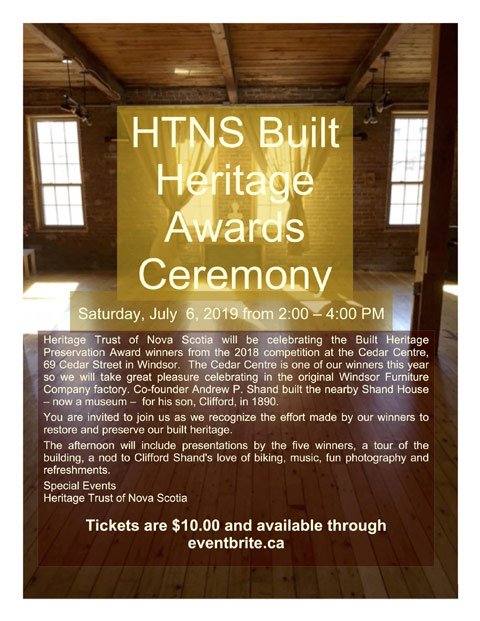
HTNS 2019 Awards Ceremony
|
|||||
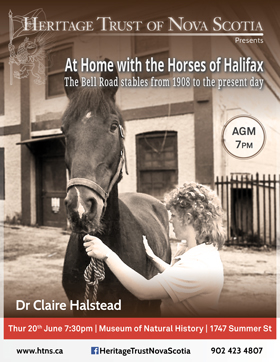
HTNS Illustrated Public Lecture SeriesAt Home with the Horses of Halifax: The Bell Road stables from 1908 to the present dayDate: Thursday, June 20 at 7:30 pm Speaker: Dr Claire Halstead Claire is a social and cultural historian specialising in Modern British and Canadian history. Her doctoral research focused on British children who were evacuated to Canada during the Second World War. As a digital historian, she is the creator of the world's only British Child Evacuee Database and HExD, the Halifax Explosion Database. Her postdoctoral project intersects with her research on twentieth-century Canada, immigration, childhood, and war and society.
|
|||||
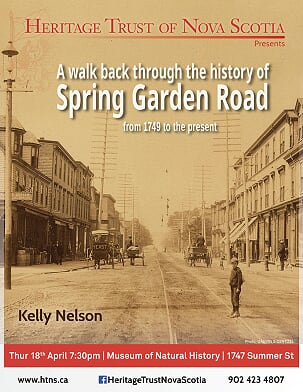
A walk back through the history of Spring Garden Road from 1749 to the present
Date: Thursday, April 18th, 2019 at 7:30 pm Speaker: Kelly Nelson Spring Garden Road has an interesting and rich history but it can only be found in bits and pieces in published works. This walk down Spring Garden Road starts with the founding of Halifax in 1749 and charts the development of the area right up to proposed new developments. Using old photos, maps and the bios of some of the distinguished residents of the street Kelly will attempt to summarize the history and character of the street over time.
|
|||||
|
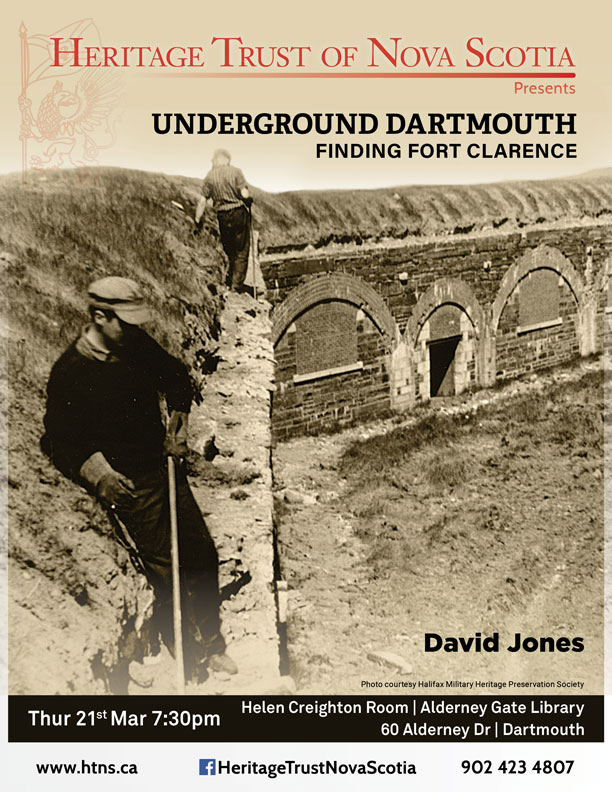
Alternate location for this event: The talk is free and everyone is welcome to attend. Underground Dartmouth: Finding Fort ClarenceSpeaker: David Jones
A passionate archaeological advocate, David Jones will deliver an exciting presentation on the buried history of Fort Clarence (underneath the former Imperial Oil Dartmouth Refinery). This talk is an enhanced and updated version of a previous presentation David made to Industrial Heritage Nova Scotia. BACKGROUND ARTICLES ON FORT CLARENCE SITE: Remember This? Imperial Oil Dartmouth Refinery built on top of Fort Clarence – HalifaxToday.caMilitary fort under Nova Scotia oil facility should be excavated, archeologist says – CBC.ca
|
|||||
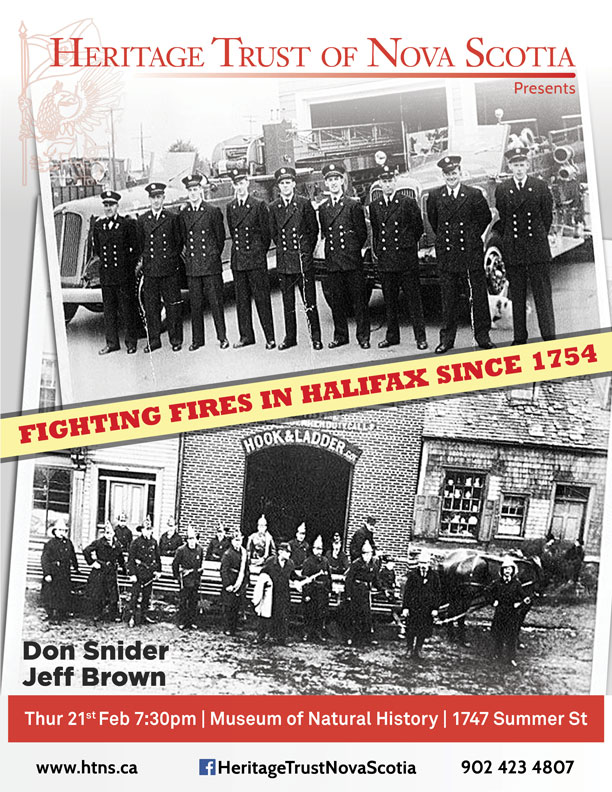
Fighting fires since 1754: the birth of the Halifax Fire Department
Thursday, February 21st, 2019 at 7:30 pm Halifax boasts the oldest fire service in Canada. Firefighters Don Snider (retired) and Jeff Brown will trace the history of the department from its birth during the early days of Halifax and through crises such as the Halifax Explosion to the present day. Their talk will be well illustrated with photos of old firehalls, some of which now serve other purposes, being of special interest. Looking to the future, they will also touch on the Regional Firefighting Interpretation Centre. Admission free—Everyone welcome!
|
|||||
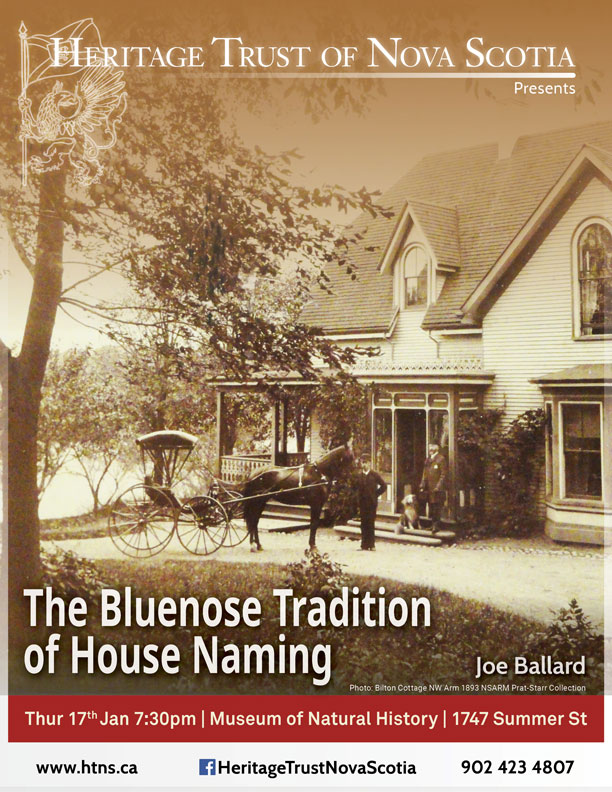
The Bluenose Tradition of House Naming
Date: Thursday, January 17, 2019 at 7:30 pm
|
|||||
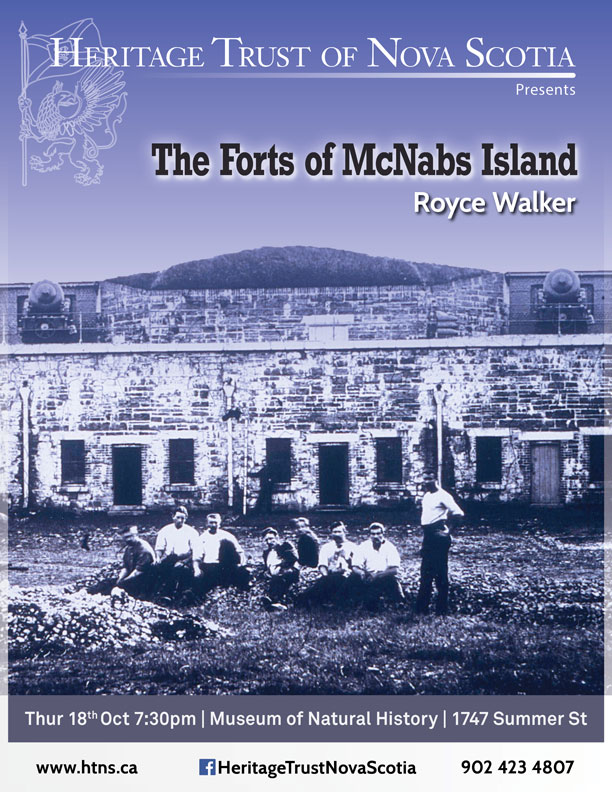
The Forts of McNabs Island
Date: Thursday, October 18 at 7:30 pm
|
|||||
Sherman Hines Guided Tour (limited attendance)
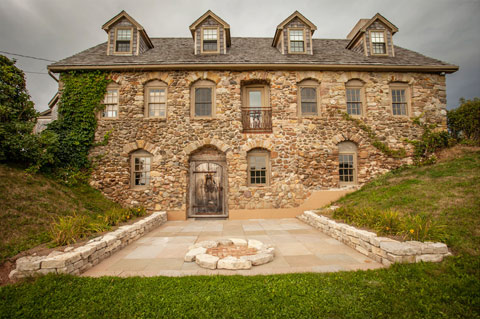
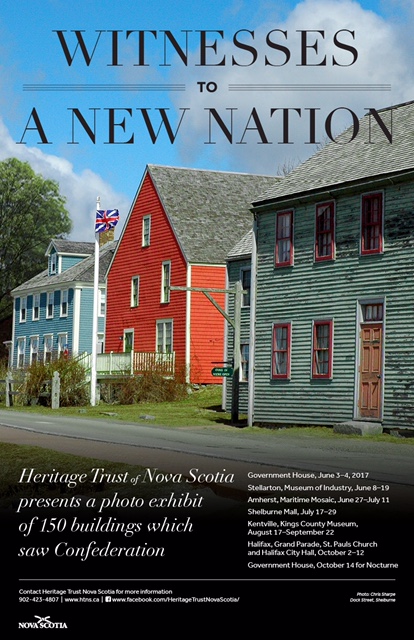
Date and Time: Sunday afternoon, October 21 at 2 pm until 4 pm Presenter: Sherman Hines Sherman Hines, internationally recognized photographer (and big-game hunter), has generously invited us for a talk and guided tour of his extensive premises at: 659 Avondale Road, Sherman Hines home appears in the Heritage Trust book Witnesses to a New Nation. It is also the featured building, in all its autumn glory, for 'October' in the Trust's 2019 calendar, Heritage on Our Doorstep. Sherman will give us a tour of the stone house and cellar, as well as the heritage barn and church moved to his property and which now form a single unit with the house. Seasonal refreshments will be catered by Cocoa Pesto, with fresh local apple juice donated by Trust member, Bob Miller, of Avondale. Lorraine Vassalo, owner of Avondale Sky Winery, will be on site for tasting and wine sales. The Trust's calendar and book, as well as Sherman Hines' new book, 2018 Guide to the Wineries of Nova Scotia, will be available. TICKETS costing $28.00 are available from EVENTBRITE.CA. Attendance is limited to 50. Information: Michal Crowe michal.crowe@ns.sympatico.ca or (902) 423-1882
|
|||||
Doors Open For Churches - a series of guided tours of Places of Worship
|
|||||
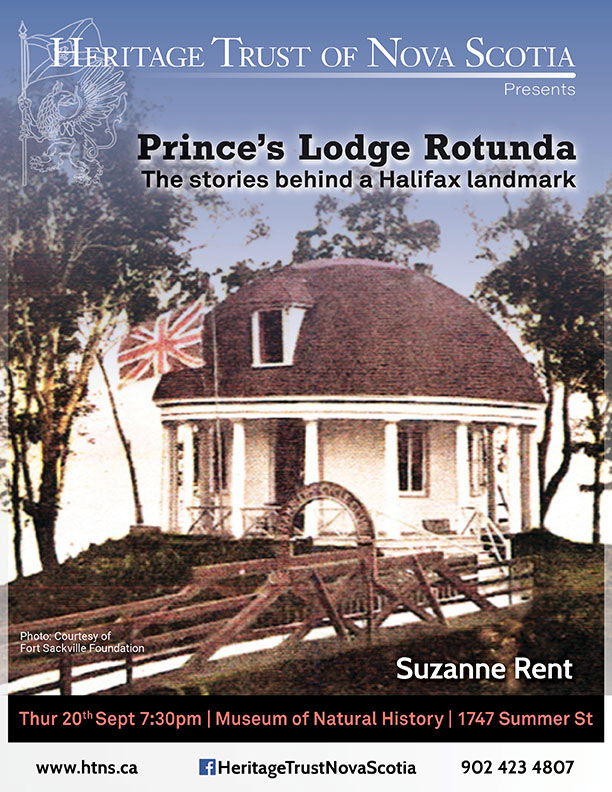
Prince's Lodge Rotunda: The stories behind a Halifax Landmark
Speaker: Suzanne Rent The Prince's Lodge rotunda on the Bedford Highway fascinates many in Halifax, the province, and beyond. This landmark fascinated Suzanne Rent, too, who decided to learn more. After a tour inside and connecting with its former caretakers, she wrote a story on the rotunda for Halifax Magazine. That story inspired a Facebook group, Save Prince's Lodge Rotunda, which collects photos and stories about Prince's Lodge, as well as other landmarks built by Prince Edward, Duke of Kent. This talk will focus on the story that inspired the Facebook group and what Suzanne is learning about the rotunda, Prince's Lodge, and the Duke of Kent through her research. Suzanne Rent is a writer based in Halifax and has worked in the media for 17 years. Her writing appears in The Chronicle Herald, Halifax Magazine, East Coast Living, and many others. She enjoys learning about heritage buildings and the stories behind them.
|
|||||
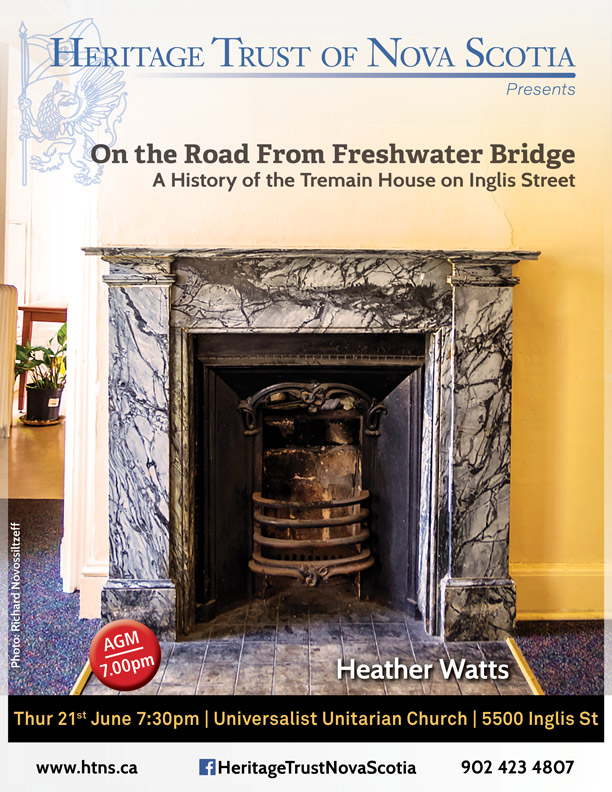
On the Road from Freshwater Bridge: A History of the Tremain House on Inglis Street
Alternate location for this event: Speaker: Heather Watts Heather Watts will reveal the history and evolution of the Tremain House, built as a cottage for a ropemaker in early Halifax and repurposed into a place of meeting and worship. The speaker has traced the building's growth through court cases, deeds, maps, and the memories and photographs of former owners' families. She has sometimes been present with a camera when plaster walls have crumbled, revealing stories and hidden messages beneath, and when new expansion has covered old features. [see more]
|
|||||
Thursday, April 19 at 7:30 pm
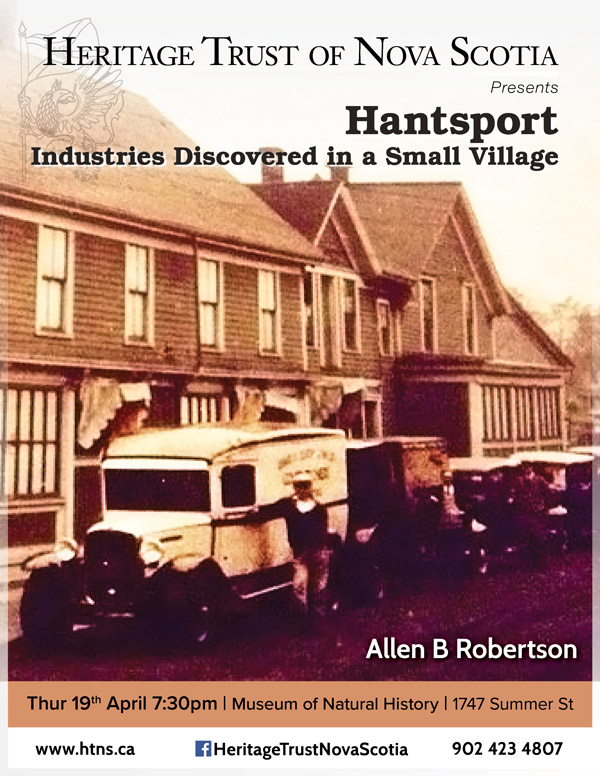
Hantsport: Industries Discovered in a Small Village
Speaker: Allen B. Robertson Hantsport, in recent memory, has been associated with paper and moulded pulp products. In the 19th century, shipbuilding, in particular by the Churchill family, was the major industry. However, other lesser-known businesses established in Hantsport, including an early prosthetics manufacturer, give a glimpse into the variety of small-scale industries to be found in Nova Scotia villages and towns.
Dr. Allen B. Robertson is an historian, author and promoter of heritage architecture preservation. His work has included examination of colonial estate management and local history studies, in addition to an account of his hometown in Tide & Timber: Hantsport, Nova Scotia 1795-1995 (1996). Urban development issues through the lens of theology and human ecology have reinforced his exploration of built landscapes and historical continuity. Recently he has been looking at the businesses and industries of Hantsport prior to its early twentieth century transformation begun by entrepreneur R. A. Jodrey. This era of inventor mechanics, wood products factory, and confectioner's kitchen to factory success will be featured in his lecture. Admission free—Everyone welcome!
|
|||||
Thursday, March 15 at 7:30 pm
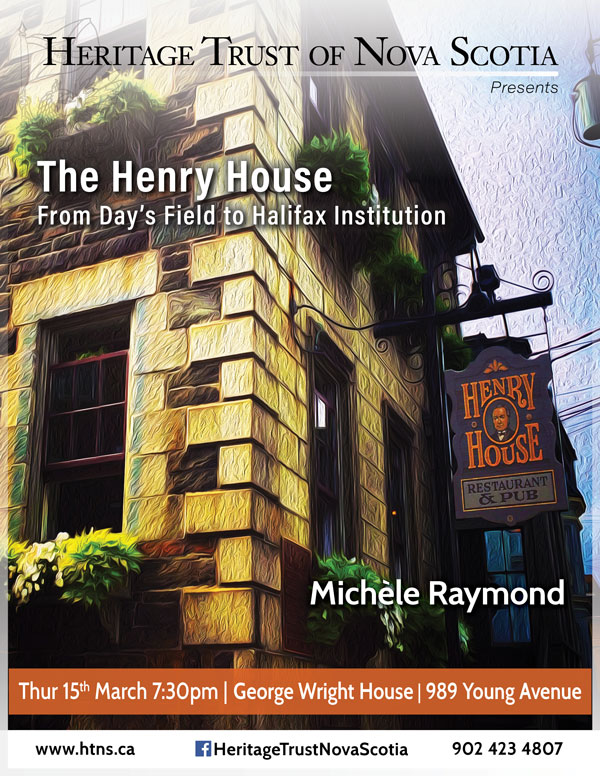
The Henry House— from Day's Field to Halifax institution: a personal history of repurposing
Speaker: Michele Raymond Alternate location for this event: Michele Raymond’s father bought the old stone house at 1222 Barrington Street in 1968, after searching for a historic property in which to open a restaurant. Halifax was a very different city then, and the South End of Barrington Street had fallen on hard times. The opening of The Henry House helped rejuvenate the area and it has now been in business for 49 years. Come share the story of a Halifax landmark, and its rescue and conversion into a new Halifax institution. Michele will explore the history of the property, from the time when the land was part of Day’s Field by the Halifax beach, through the 1830s construction of the house in the fashionable new South Suburb near Government House, to later residential days and its eventual renovation and restoration as a restaurant and tavern. The house had been home to Sir William Alexander Henry, MLA, Father of Confederation and Nova Scotia’s first judge on the Supreme Court of Canada. It has lodged many others since and served as the Navy League’s Home for sailors ashore in the early 20th century. Michele Raymond has served as a member of HRM’s Heritage Advisory Committee, she is a former vice-president (heritage) of Heritage Trust of Nova Scotia, and was the MLA for Halifax Atlantic (2003—2013). She co-authored the book Halifax’s Northwest Arm: an illustrated history.Admission free—Everyone welcome!
|
|||||
Thursday, February 15 at 7:30pm
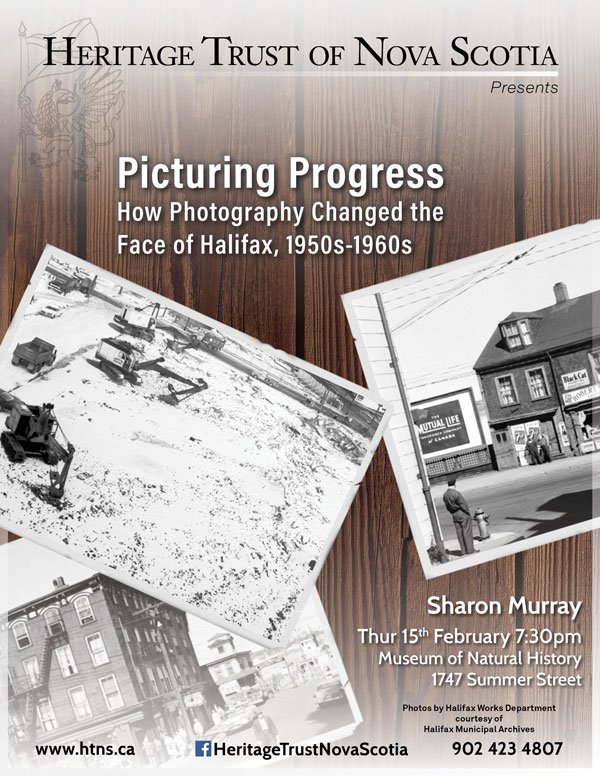
Picturing Progress: How Photography Changed the Face of Halifax, 1950's - 1960's
Speaker: Sharon Murray This presentation examines the role that photography played in facilitating the urban renewal of Halifax's downtown in the 1950s and 1960s. During this period, thousands of homes and businesses in the city were razed to make way for redevelopment, many of which were photographed by Building Inspectors working for the City. Now housed in the Halifax Municipal Archives and recently made available online, these photographs are some of the only remaining traces of the downtown prior to its transformation and how life was lived therein. Not only does this collection of photographs offer the public an opportunity to connect with the city's past – a Halifax that no longer exists – but it also puts into view the ideas and values that facilitated the city's redevelopment. Admission free—Everyone welcome!
|
|||||
- 2017 -
|
|||||
HTNS Illustrated Public Lecture Series
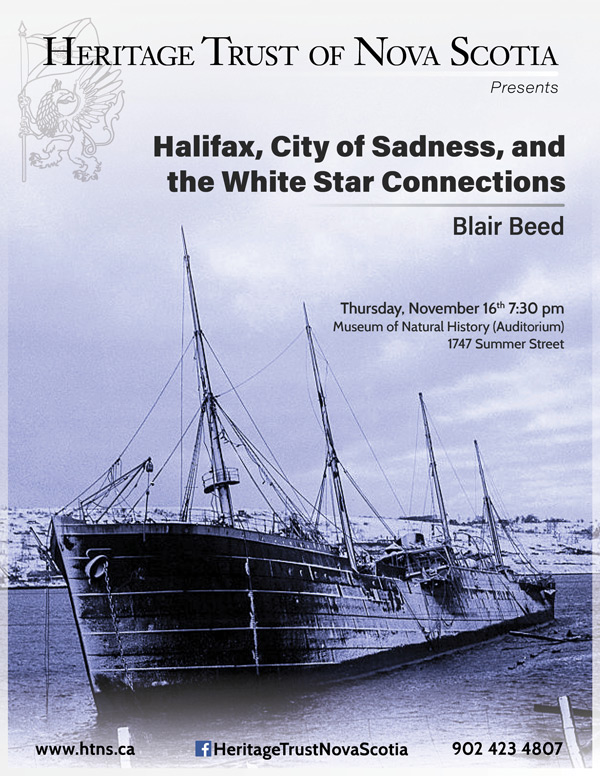
Museum of Natural History, 1747 Summer Street, Halifax. Halifax, City of Sadness, and the White Star ConnectionsSpeaker: Blair Beed A local historian and tour guide, Blair Beed has a special interest in the Titanic, the Halifax Explosion, and in St Patrick's Parish in north end Halifax. "Halifax, City of Sadness, and the White Star Connections" will look at buildings and stories related to the Halifax Explosion in 1917 and the Titanic sinking 5 years earlier. Blair Beed, is very involved with Saint Patrick's Church on Brunswick Street in Halifax and is a life member of the Heritage Trust of Nova Scotia. He first presented this talk to the British Titanic Society in April of this year. Blair is coordinating an exhibit on the Halifax Explosion in St Patrick's church hall from November 23 to December 6. He has two books on the Explosion: 1917 Halifax Explosion and American Response (Nimbus Publishing) and L'explosion de 1917 à Halifax et les secours américains (Dtours). Admission free—Everyone welcome!
|
|||||
HTNS Illustrated Public Lecture Series
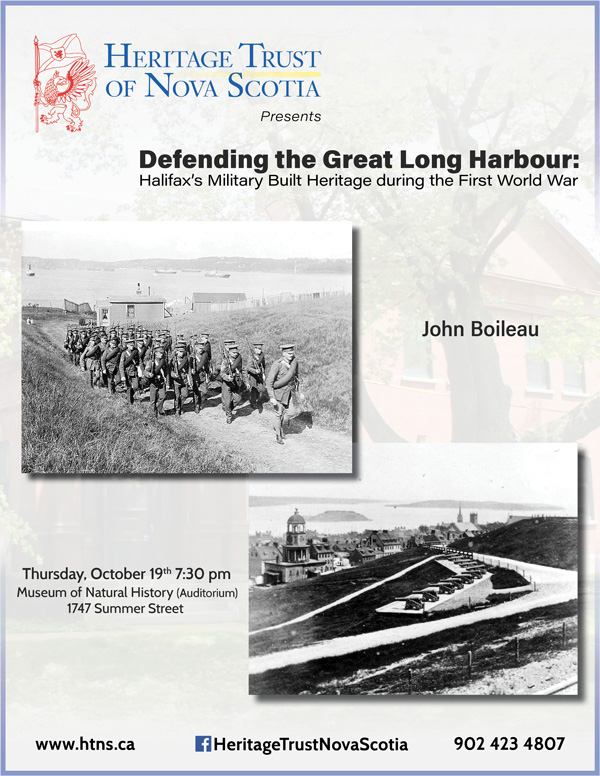
Museum of Natural History, 1747 Summer Street, Halifax. Defending the Great Long Harbour: Halifax's Military Built Heritage during the First World War.The speaker is: Col. John Boileau (Ret'd) In 1905-06, after more than 150 years of use as an important port and garrison town, the Royal Navy and British Army ended the permanent British military presence in Canada with the departure of the last imperial troops from Halifax. The British left behind them vast and valuable buildings and facilities, among them the Citadel, Royal Artillery Park, Wellington Barracks, Admiralty House and the Dockyard, as well as several forts and batteries, all of which were turned over to the Dominion government. Without a navy, Canada had no use for the dockyard—but agreed to maintain it for Britain in case of an emergency—while the needs of the country's militia and its even smaller permanent force were minimal. Then, in less than 10 years, Canada had its own navy and the First World War had begun. Suddenly, buildings and facilities no longer in use were now needed, while several more were built to house the requirements of a rapidly-expanding wartime navy and army. Join John Boileau as he summarizes the military's built heritage that existed at the start of the war and describes additions made during the war, including the repurposing of existing non-military infrastructure. John Boileau served in the Canadian Army for 37 years in Canada and abroad, retiring as a colonel in 1999. In retirement, John commenced a second career as a writer and has authored more than 500 magazine and newspaper articles, as well as thirteen books. His latest book, 6•12•17: The Halifax Explosion, was released in August. John is an active volunteer and was the founding chairman of the Halifax Military Heritage Preservation Society in 2015. John has received two honours from the Lieutenant-Governor of Nova Scotia for his contributions to the history and heritage of the province: the Queen Elizabeth II Diamond Jubilee Medal in 2012 and a Vice-Regal Commendation in 2016. Admission free—Everyone welcome!
|
|||||
HTNS Illustrated Public Lecture Series
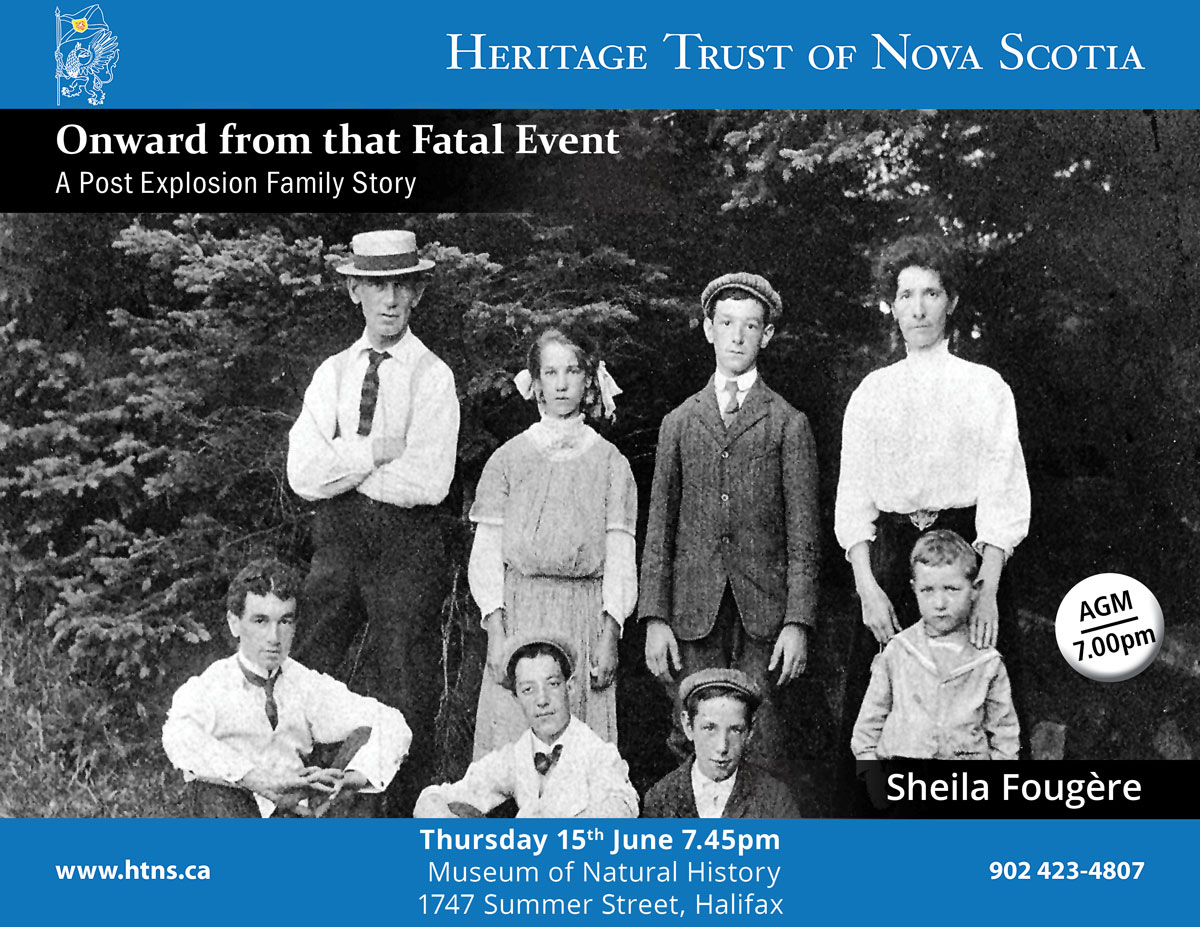
Museum of Natural History (Auditorium), 1747 Summer Street, Halifax. Onward from that Fatal Event - A Post Explosion Family StoryFormer councillor, Sheila Fougere, will be talking about the impact of the Explosion on her grandfather's family. Although she had always known about the family's history, the enormity of what had happened and the effect it had on their lives only hit home when she came across a cache of documents in her father's attic, after his death. Her grandfather, James P. Vaughan, was a builder living in the North End. He lost family members from three generations as a result of the Explosion. Scanned and some original material will be on display. Sheila Fougere is a lifelong Haligonian, granddaughter of a Halifax Explosion survivor. She has worked as a public administrator, event organizer, and city councillor. She is a musician, athlete, and lifelong volunteer, with an enduring love of Halifax. Admission free—Everyone welcome!
|
|||||
|
|||||
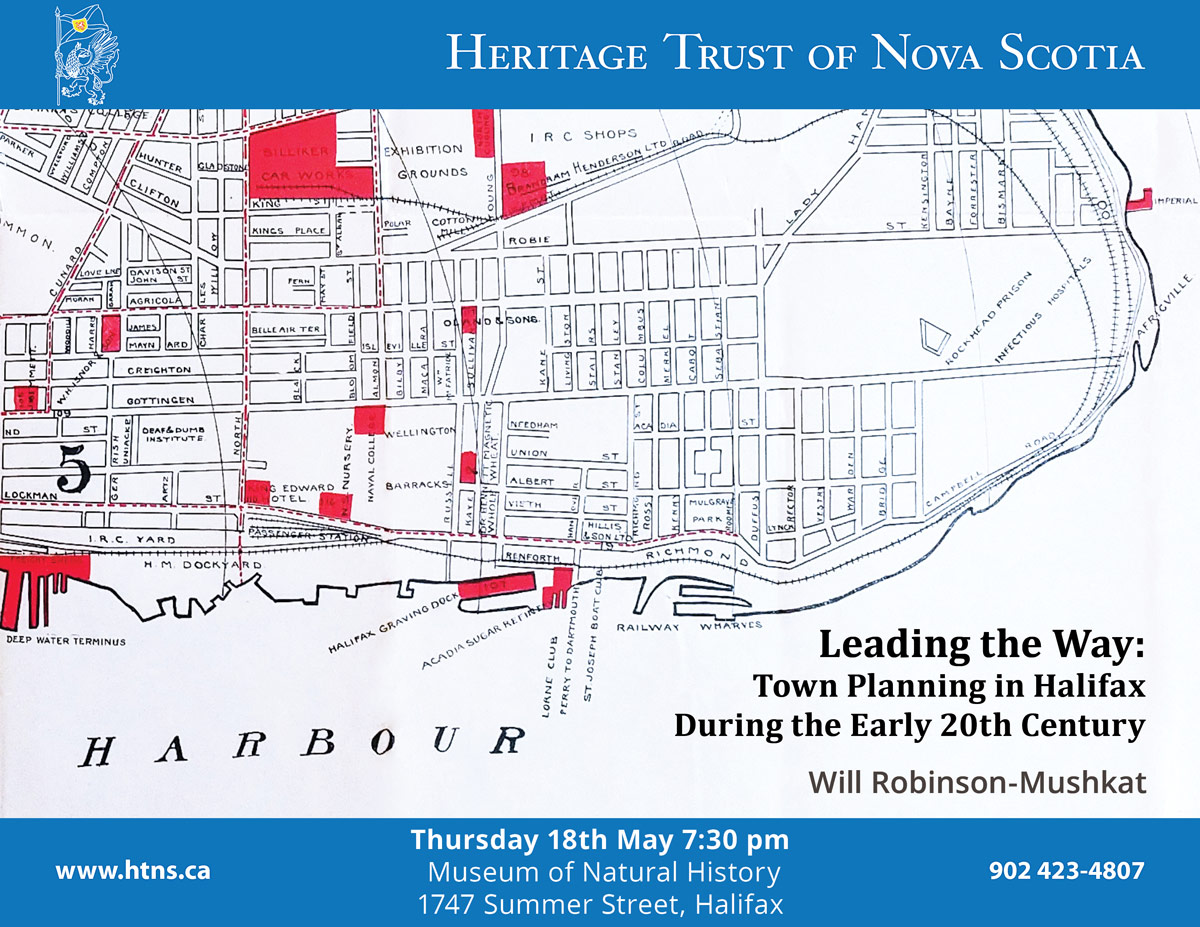
HTNS Illustrated Public Lecture SeriesMuseum of Natural History Leading the Way: Town Planning in Halifax During the Early 20th Century.Speaker: Will Robinson-Mushkat Early 20th Century Town Planning was a direct result of the negative repercussions of rapid, unchecked industrialization and urbanization of cities. Halifax, like many other towns and cities during the early 20th century, sought to effectively control urban growth and development in a manner which would not only allow for efficient and sustainable land-use, but also as a means of ensuring improved public health and a reduction in vice and other social ills -‒ genuine or manufactured. With enthusiastic local champions, funding and support at the Federal level of government, and the consultation of internationally renowned experts, Nova Scotia developed some of the most advanced legislation regarding town planning for the time. During this period, Halifax was one of the most progressive municipalities in Canada with regards to the practice of planning, with ambitious ideas for future growth and development. However, a confluence of factors emerged in the late 1910s and early 1920s which stalled the implementation of town planning in Halifax. Will Robinson-Mushkat has studied both the history and practice of urban planning. Born and raised in Halifax, he has a keen interest in the promotion of the history and heritage of the city. The contents of this lecture are derived from research which he completed for his M.A. Thesis (2010) at Saint Mary's University. Admission free—Everyone welcome!
|
|||||
HTNS Illustrated Public Lecture Series
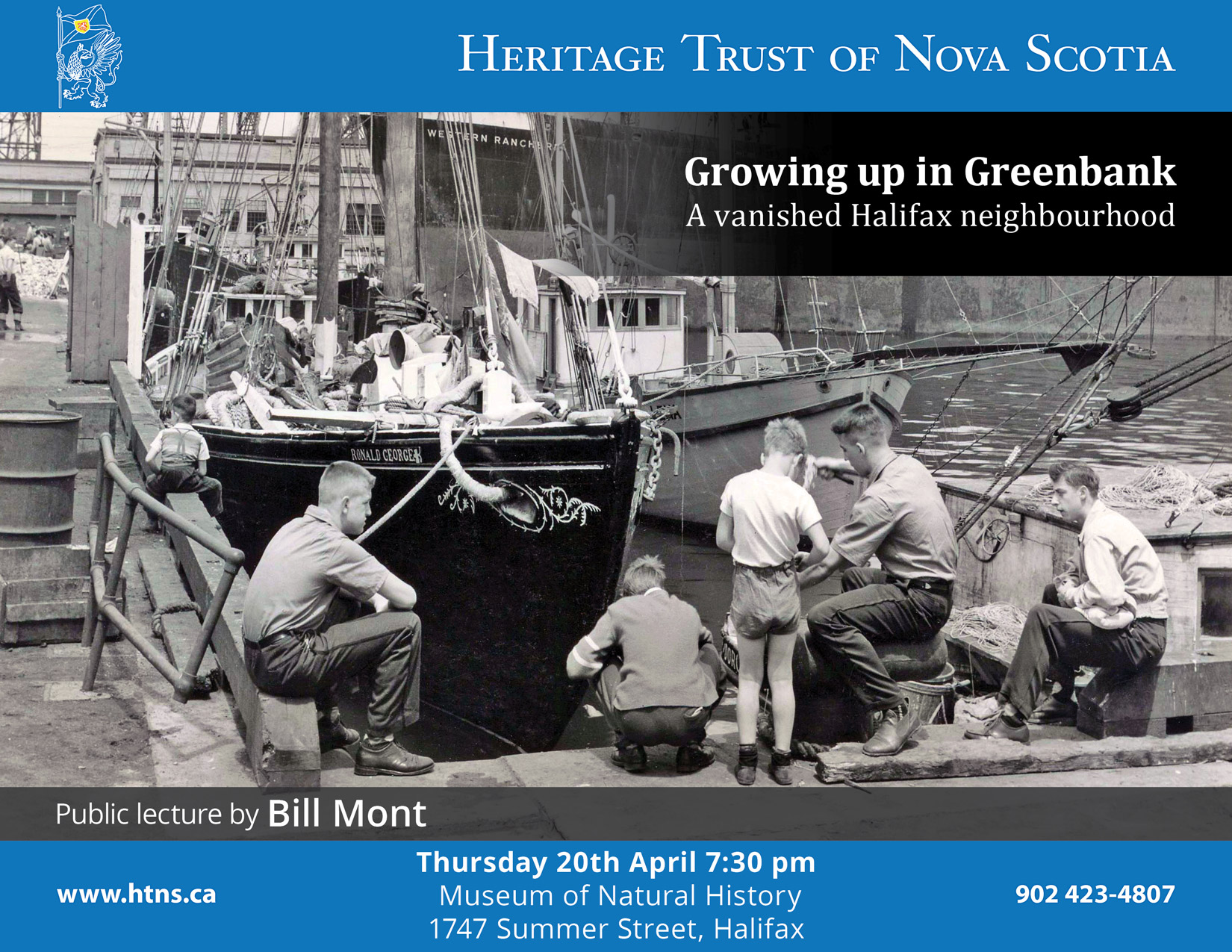
Museum of Natural History Growing up in Greenbank: A vanished Halifax neighbourhoodSpeaker: Bill Mont "In the early 1900s, few homes existed in the area known as Greenbank, the area between Young Avenue and the harbour… By 1915, Greenbank had become a tarpaper village when the ICR built a railway shantytown without running water for the workers near Brussels and Clarence streets." (Barry Copp, "Halifax's South End Railway Cut," The Griffin, March 2013, p.13) In Sailors, Slackers and Blind Pigs, Stephen Kimber wrote that the houses "were supposed to have been torn down after the terminals opened, but they survived. Families took them over, put additions on. Other folks built new cottages nearby. …Billy's grandfather paid five dollars a month for their two-bedroom cottage, which had no running water, sewage or other city services, to Susan Mack, the widow of a prominent Halifax doctor." Born in 1929, "Billy" was Bill Mont. Greenbank was the setting for his childhood and early entry into the world of work. It was also the place he left to attend school in the adjacent middle class neighbourhood. Bill Mont has had many careers, beginning at age 11 with the Halifax Shipyards, and including the purchase of the oldest auction house in Canada, Melvin S. Clarke. He has demonstrated a longstanding interest in preserving heritage buildings, such as the Parrsboro Post Office, and objects ranging from historical photographs to a ferry boat. A recipient of the Queens Jubilee Medal, he was awarded the Halifax Volunteer Award in 2016. Admission free—Everyone welcome! |
|||||
HTNS Illustrated Public Lecture Series
St George's Round Church,
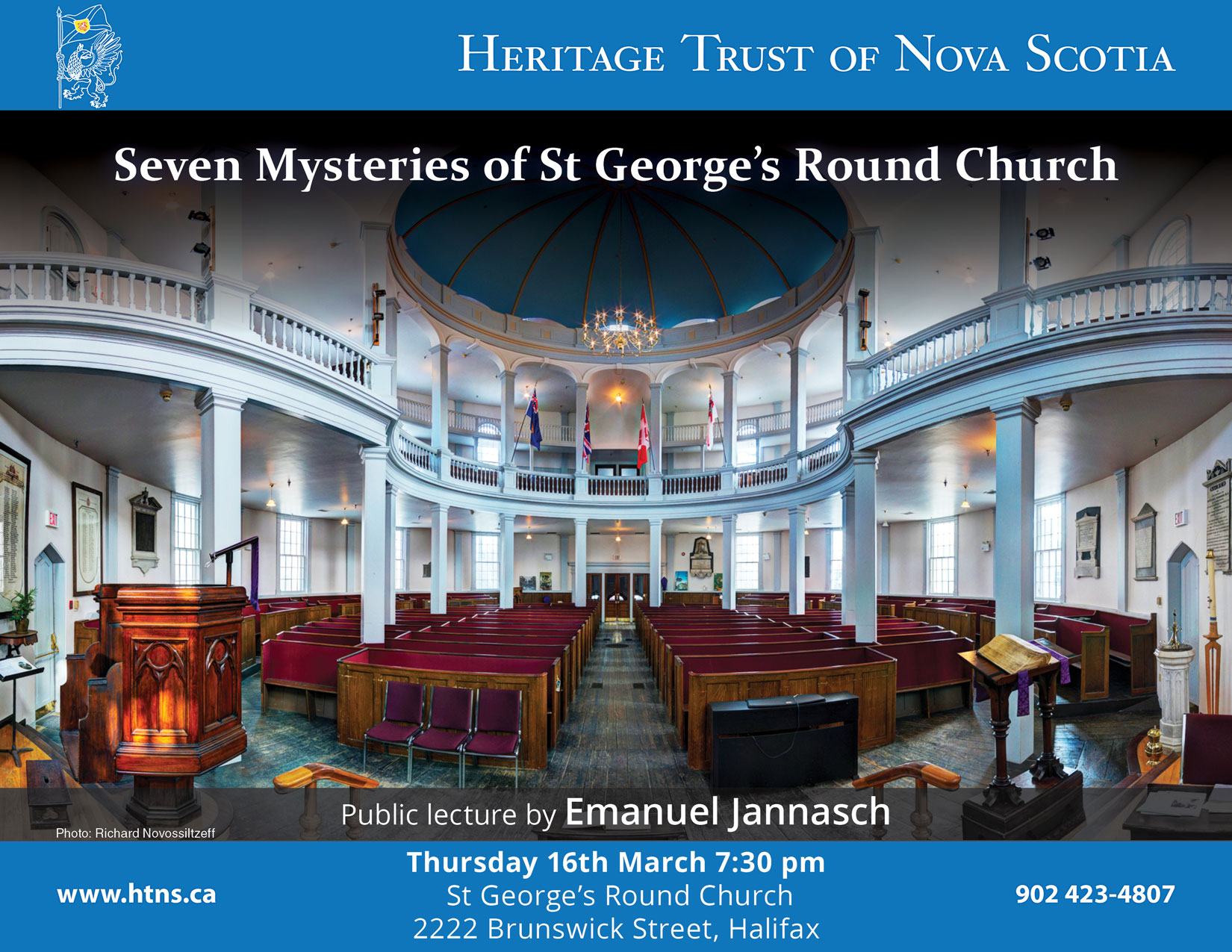
Seven Mysteries of St. George's Round ChurchSpeaker: Emanuel Jannasch How many times have you passed by St. George's, "The Round Church," and wondered about its origins? Was it really inspired by Queen Victoria's father, the Duke of Kent, during his stay in Halifax? Architect Emanuel Jannasch has asked himself this and other questions about the origins of St George's Round Church, its evolution from "gaunt" and "ungainly" to "masterpiece", its remarkable framing, why it is circular and who devised the remarkable dome. In exploring answers to these questions the speaker will engage the audience in the discussion. It should be a lively evening. Emanuel Jannasch earned a Masters degree in Architecture from Dalhousie in 1998. He is a senior instructor in the School of Architecture at Dal. Among other courses he teaches is "Building Technology." His research interests include the interplay of architecture and film. He was the production designer of the 1998 film "New Waterford Girl" and was nominated in 2000 for a Genie award for his work on the film. He also worked on "Margaret's Museum". Admission free—Everyone welcome! |
|||||
Heritage Day
Heritage Day,
Celebrate Heritage DayCome and celebrate Heritage Day with us on Sunday, February 19th from 10 am to 4 pm when we visit "Bloomingdale," the 1861 summer home built for Alfred Gilpin Jones, a former Lieutenant Governor. It is now the Waegwoltic Club, 6549 Coburg Road, Halifax. Drop by for a tour or come for the party! Tickets are $25 and must be ordered by February 13. Payment may be made by e-transfer (to treasurer@htns.ca ) or by cheque (send to Heritage Trust of NS, PO Box 36111, Spring Garden Rd RPO, Halifax B3J 3S9). Information from membership@htns.ca or 902-423-1882. |
|||||
HTNS Illustrated Public Lecture Series
Museum of Natural History Auditorium,
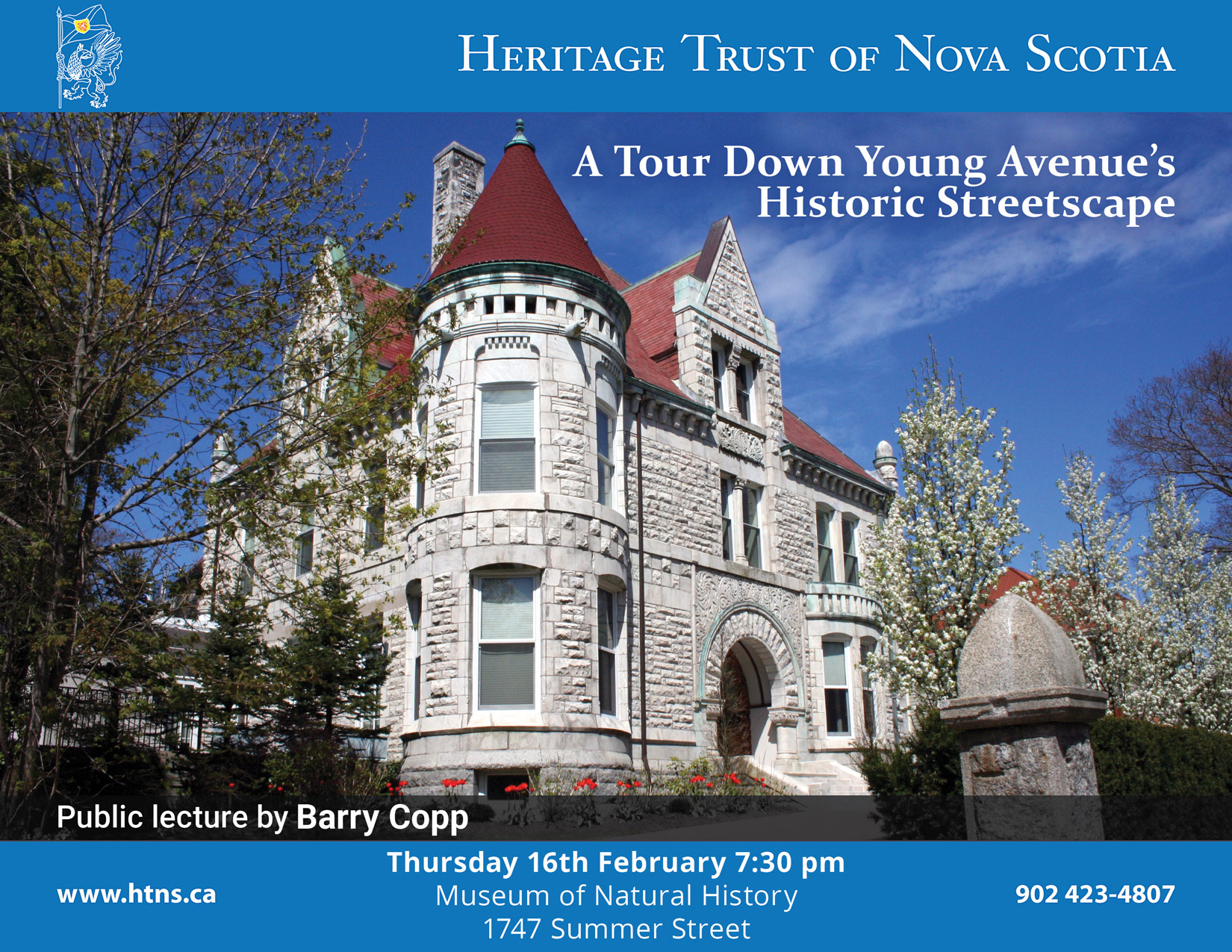
A Tour Down Young Avenue's Historic StreetscapeSpeaker: Barry Copp Young Avenue is perhaps one of the most unusual and beautiful avenues in Nova Scotia. It was originally designed by Sir William Young as a grand avenue with impressive homes set back from the street leading to Point Pleasant Park's entrance and its famous golden gates. This unique streetscape was part of the City Beautiful movement sweeping across North America during the 1890s and 1900s. A number of important Nova Scotians made this avenue their home. Preservation and adaptive re-use are key to keeping this important historic streetscape and identity from poor development and misuse. Barry Copp is a native of Halifax's South End, with an artistic background and deep appreciation of heritage buildings. After graduating from NSCAD with a Bachelor of Design in Communication Design, he worked as a graphic designer and media developer for three of Canada's major international airlines. As well, he worked for almost 25 years as a senior technical illustrator for an aerospace firm. Among his design projects were interior furnishing assembly drawings for Canada's Prime Minister's official plane, – a CC-150 Polaris. No stranger to an appreciation of his past, Barry has illustrated over 250 heritage homes of Nova Scotia in his spare time. This is an addition to, his other illustrations and caricatures, both in hand drawings and on computer. Barry also contributed to Heritage Trust of Nova Scotia's March 2013 quarterly, The Griffin, with the Heritage Lost article: Halifax's South End Railway Cut. Having had relatives living in Young Avenue's beautiful Floravista mansion for many years, Barry became a member of the Save Young Avenue Group, serving as its historical research arm. Admission free—Everyone welcome! |
|||||
HTNS Illustrated Public Lecture Series
Museum of Natural History Auditorium,
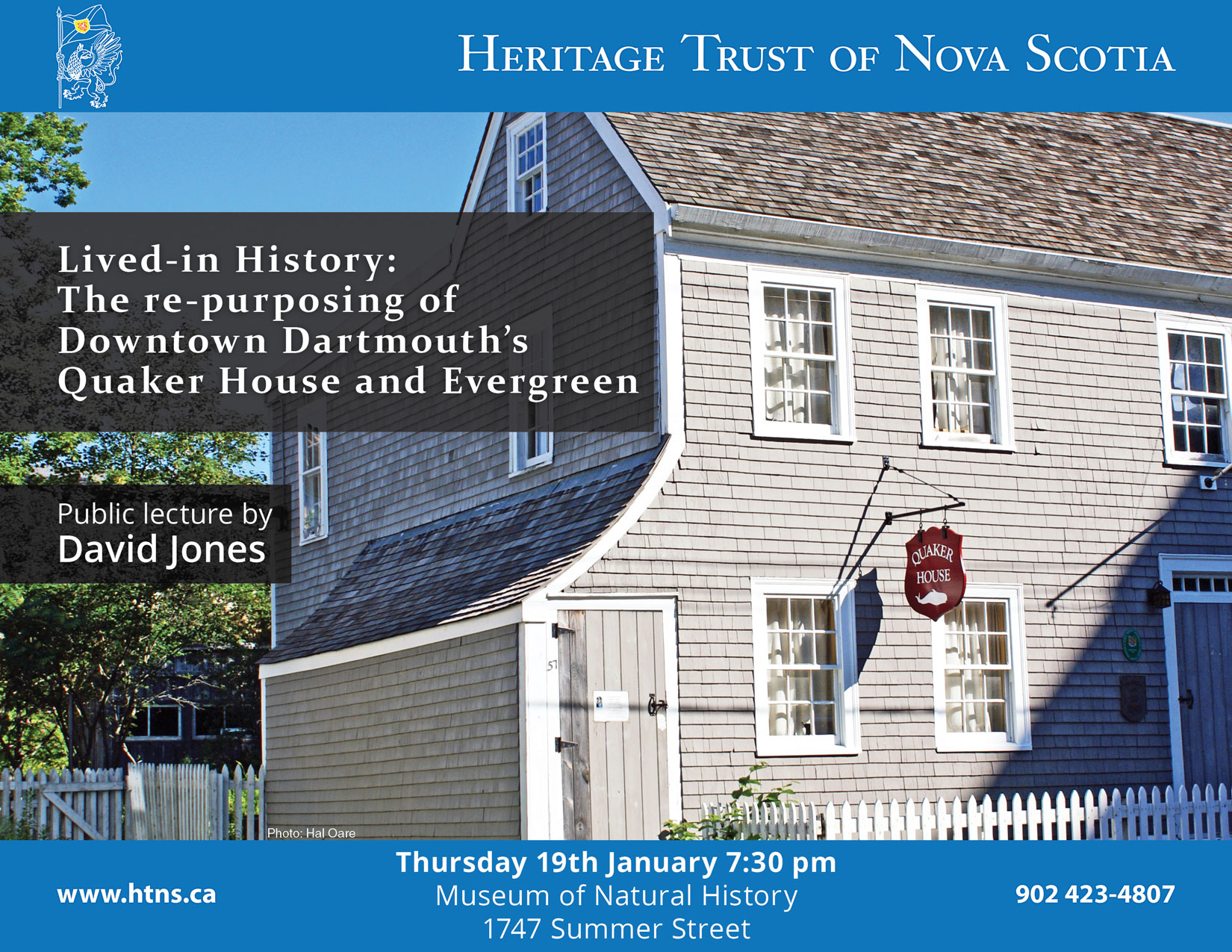
Lived-in History: the re-purposing of Downtown Dartmouth's Quaker House and EvergreenSpeaker: David Jones The extensive and significant material culture collection of the City of Dartmouth is currently out of public view in a Burnside storage facility. While waiting for a proper and permanent home, the Dartmouth Heritage Museum operates out of two historic buildings: Evergreen and Quaker House. 2017 marks not only the 150th anniversary of Confederation but also of the construction of Judge Alexander James' Evergreen (famous as the home of folklorist Helen Creighton for almost six decades). Quaker House, notably, is the oldest known surviving building in Dartmouth (1785) and is an integral feature of a potential Downtown Dartmouth Heritage District. Join David Jones, a strong advocate for cultural heritage, for an illustrated and lively discussion of the 'lived-in history' of these notable Dartmouth museum houses. David Jones is an archaeologist and historian from Dartmouth, Nova Scotia. He sits on the Board of Directors of the Dartmouth Heritage Museum Society. David is the great grand nephew of Dr. John P. Martin, Town Historian of Dartmouth. Recently graduated from Saint Mary's University, David has conducted archaeological excavations and geophysical prospections on sites across Nova Scotia. Admission free—Everyone welcome! |
|||||
HTNS Illustrated Public Lecture Series
Museum of Natural History Auditorium,
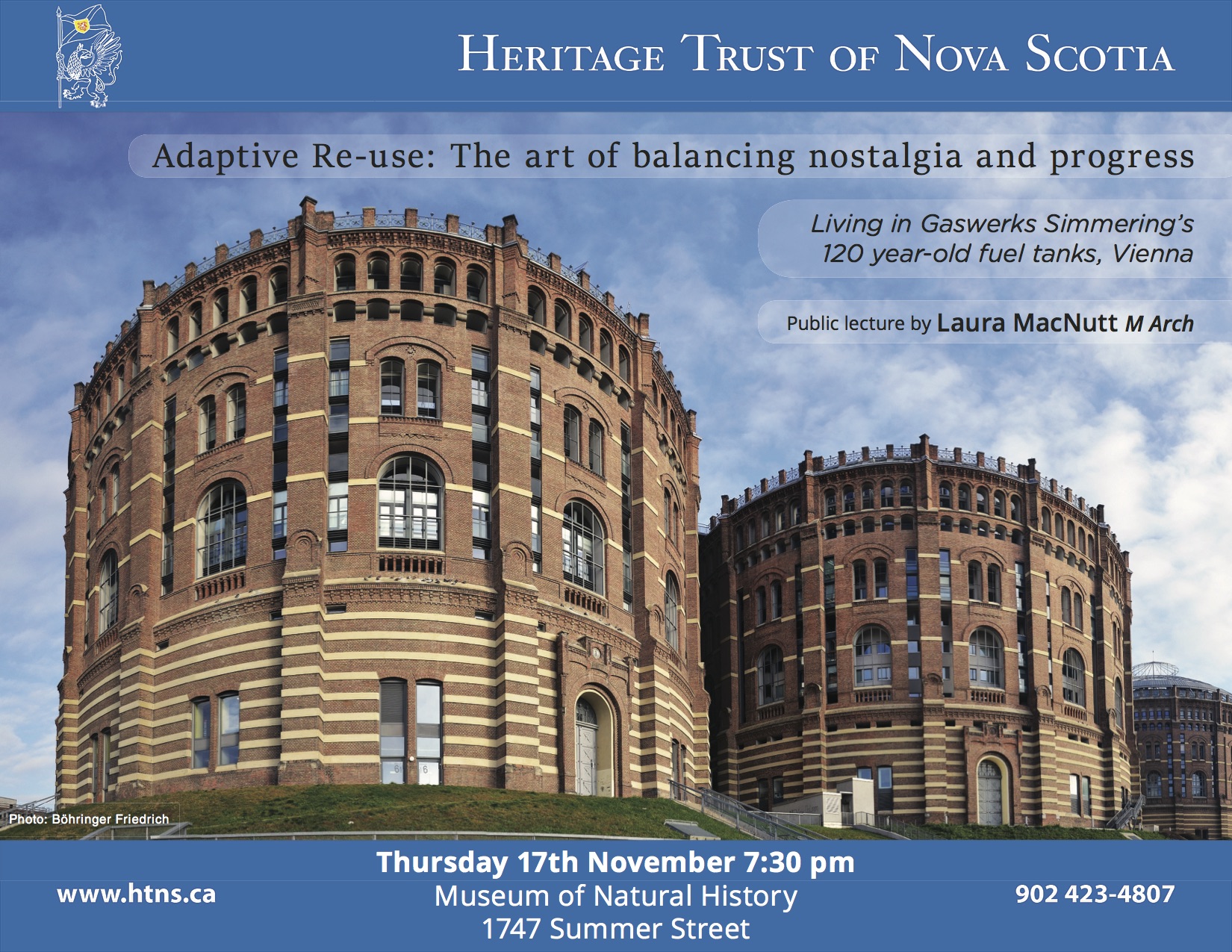
Adaptive Re-use: The art of balancing nostalgia and progressSpeaker: Laura MacNutt, M Arch The prospect of adaptive re-use is often the catalyst for adversarial discussions between preservationists and developers. Preservation of built heritage is necessarily a pragmatic issue. However, the inherent value of the building is often overlooked and misunderstood. How can we adopt successful strategies when faced with inventories of obsolete buildings? We must shift the conversation. Laura MacNutt argues that it is not the building which must adapt but rather it is we who must rediscover the values of built heritage and adapt our approach. She will introduce Gasometer City in Vienna, Austria, where late 19th century industrial buildings are transformed to residential units by four independent architects, successfully preserving cultural equity, while contributing to progressive development of a community. Laura MacNutt is a Dartmouth native, proudly influenced by the artistic careers of both her parents. After studying fine arts at Mt Allison, she completed Bachelor of Environment Design and Master of Architecture degrees at TUNS. For the following 10 years, she joined design teams in Toronto, Victoria, Iqaluit, Berlin, and Bermuda before returning to Nova Scotia. Laura complements her professional design work with a vintage retail business in Dartmouth, KingsPIER Curated Collections, which is appropriately housed in the obsolete premises of a purpose-built interpretive centre. Admission free—Everyone welcome! |
|||||
HTNS Illustrated Public Lecture Series
Museum of Natural History Auditorium,
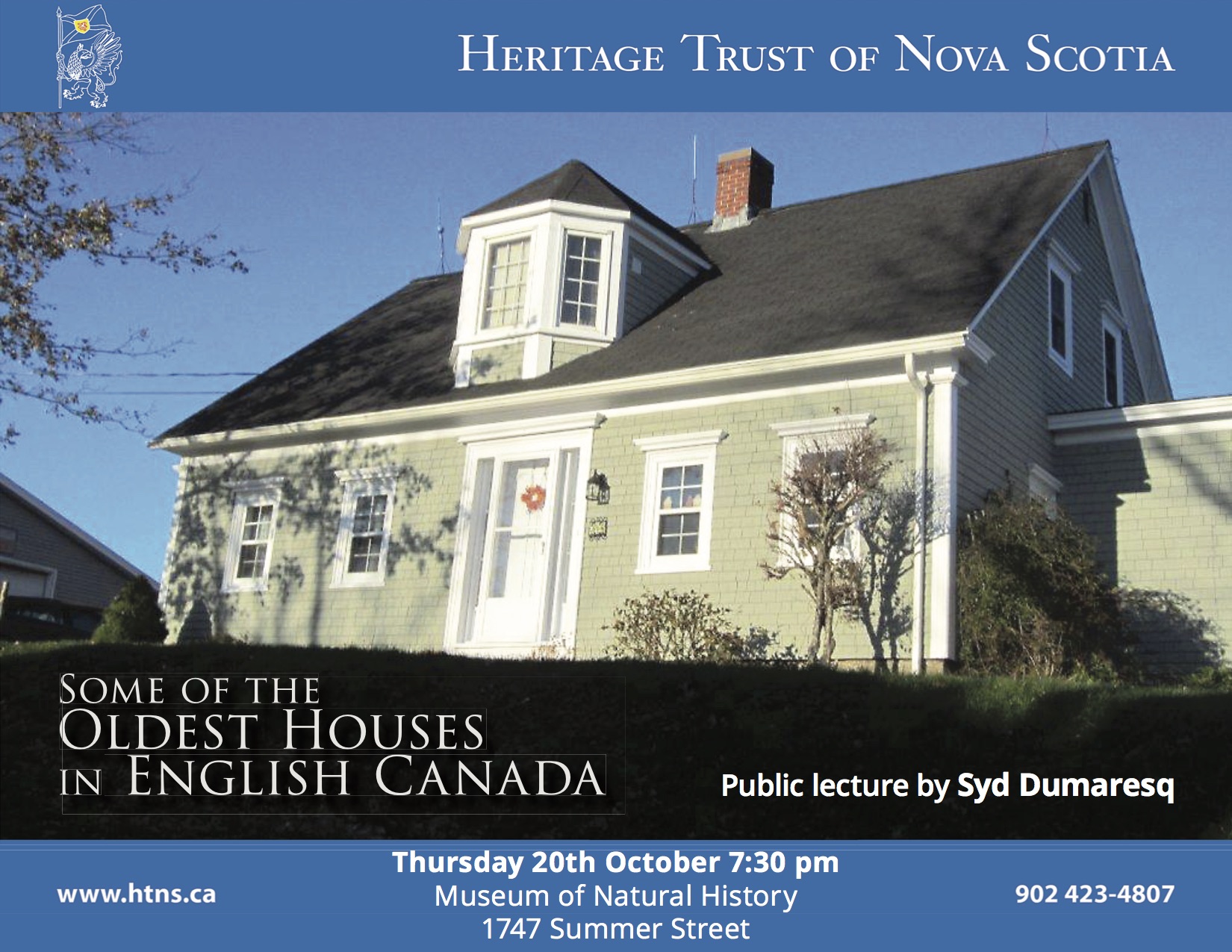
Some of the Oldest Houses in English CanadaSpeaker: Syd Dumaresq Some of the Oldest Houses in English Canada will take us on a guided tour of houses in the Chester area. The oldest houses in English Canada are in Halifax, Annapolis Royal and Lunenburg County. Nova Scotia was first settled by Acadians in 1604. Even seven generations later, when Halifax (1749) and Lunenburg (1752) were founded, the area we now know as Canada was sparsely settled. Toronto for example had a French trading post in 1750 but was only ceded to the English in 1788, nearly 40 years after Lunenburg was settled. Join us as Syd Dumaresq gives an entertaining and informal walk through the Lunenburg County he loves, presenting some of the oldest houses in English Canada. Syd Dumaresq is a fourth generation architect who has followed in the footsteps of his father Phil Dumaresq, his grandfather Sydney Perry Dumaresq, and his great grandfather J.C. Dumaresq. The four men have cumulatively designed over 100 buildings in Halifax in the last 145 years. Syd Dumaresq is the President of SP Dumaresq Architect Ltd. Admission free—Everyone welcome! |
|||||
HTNS Illustrated Public Lecture Series
Museum of Natural History Auditorium,
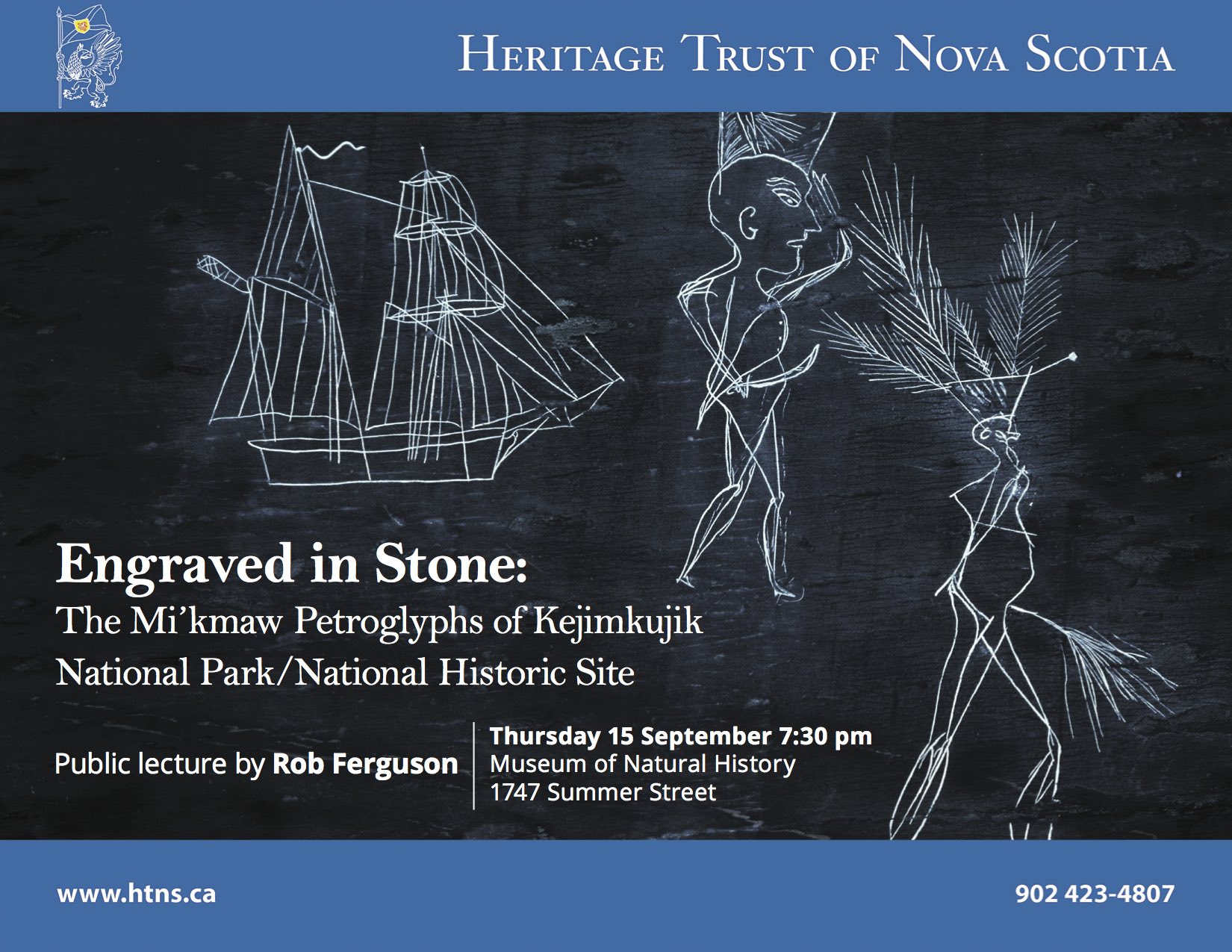
Preserving a Legacy: The Mi'kmaw Petroglyphs of Kejimkujik National Park/National Historic SiteSpeaker: Rob Ferguson The history of First Nations people in Nova Scotia stretches back 13,000 years, to the early post-glacial period. The petroglyphs, or rock carvings, of Kejimkujik represent a late manifestation of that presence, created largely in the 19th century. Consisting of over 400 images at four different sites around Kejimkujik Lake, they are an extensive artistic gallery of many aspects of Mi'kmaw society: economy, religion, society, material culture. They are also one of the key components of the cultural landscape of Kejimkujik National Historic Site recognized by the Historic Sites and Monuments Board of Canada in 1996. Retired archaeologist, Rob Ferguson, will situate the sites in the context of Mi'kmaw history, discuss the range of images shown and show the methods of recording to preserve the images for future generations. Admission free—Everyone welcome! |
|||||
HTNS Illustrated Public Lecture Series
Museum of Natural History Auditorium,
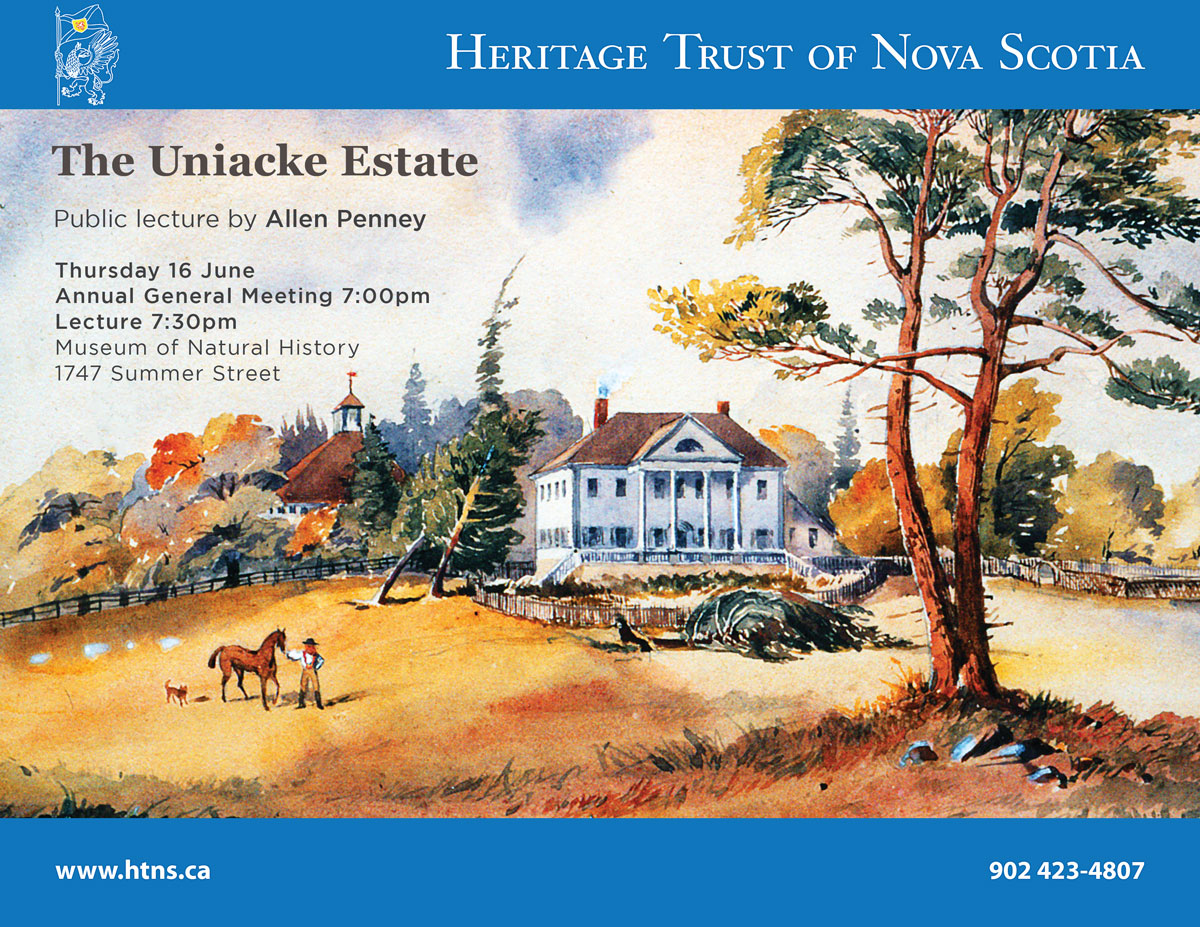
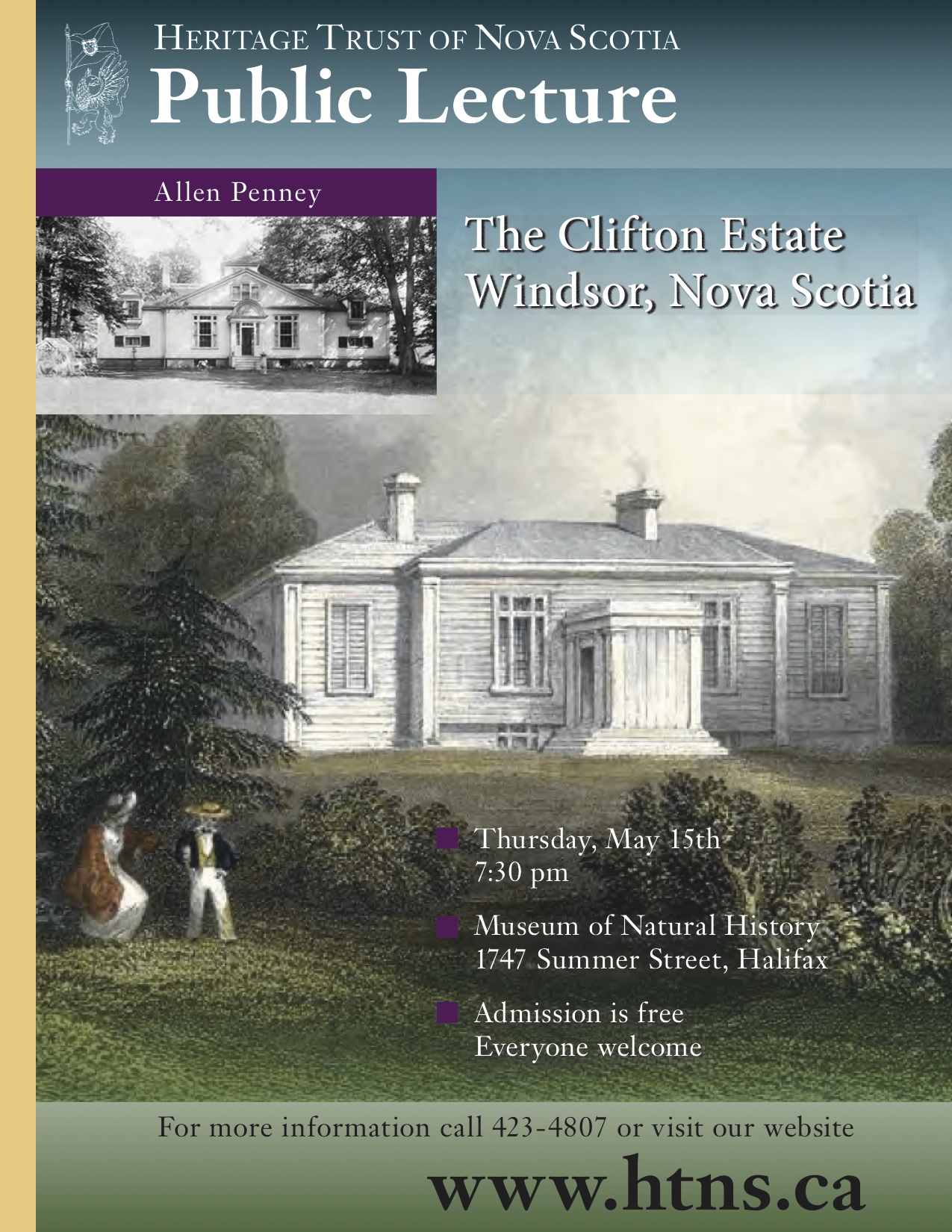
Main Floor Gallery (entrance from side door parking lot) (Please note: access from main entrance will also be available because of event in parking lot) The Uniacke EstateSpeaker: Allen Penney Attorney-General Richard John Uniacke (1753-1830 ) built his Georgian country house, Mount Uniacke, two hundred years ago. Remarkably, for the first 135 years of its existence, Uniacke's estate remained in the hands of his family. For the past 65 years, the Province of Nova Scotia has been the steward of the house. Of Uniacke's original 20 buildings, four remain. Biographer, Dr. Brian Cuthbertson, says that "Mount Uniacke is today a historic house open to the public, where the personality of a 'remarkable and extraordinary man' still lives." (Dictionary of Canadian Biography on-line) Retired architect, Allen Penney, will discuss what is known about the estate and its buildings, what knowledge has been lost, how the estate has developed, and what the current needs are of this wonderful legacy of two centuries ago. Admission free—Everyone welcome! |
|||||
HTNS Illustrated Public Lecture Series
Museum of Natural History Auditorium,
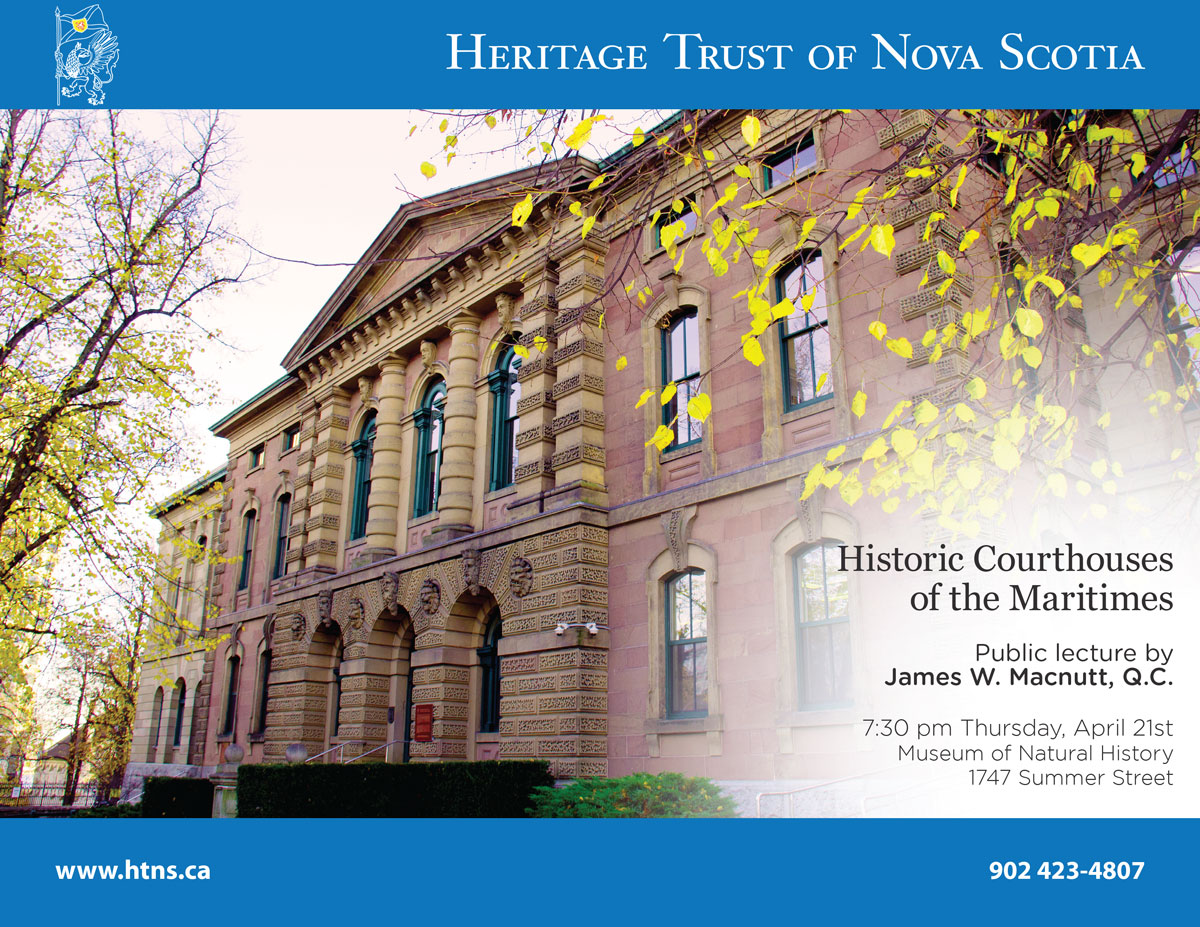
Main Floor Gallery (entrance from side door parking lot) Historic Courthouses of the MaritimesSpeaker: James W. Macnutt, Q.C. Based on Building for Justice, and with reference to Building for Democracy, Mr. Macnutt will demonstrate that the interior layout and decorative elements of formal structures like Courthouses and Legislative buildings explain the functions performed in the buildings. The talk is also an explanation of the early adoption and use of neoclassicism in public buildings in the Maritimes. This will be a celebration of some of the finest buildings in Canada of their type. James W. Macnutt is the author of Heritage Houses of Prince Edward Island; Inside Island Heritage Homes; The Historical Atlas of Prince Edward Island; Building for Democracy/The History and Architecture of the Legislative Buildings of Nova Scotia, Prince Edward Island and New Brunswick; and Building for Justice/The Historic Courthouses of the Maritimes. He is the author of several journal articles on architectural history. At the request of the National Assembly of Quebec, in conjunction with its 125th anniversary publication, he prepared a comparative analysis of the Quebec National Assembly building with that of the Province of New Brunswick. Mr. Macnutt is a Queen's Counsel and has been a practising lawyer in Prince Edward Island since 1969. His activities have included collecting works on paper such as maps, views and architectural renderings. He is an ardent advocate for the preservation of the built heritage of the Maritime provinces of Canada. Admission free—Everyone welcome! |
|||||
HTNS Illustrated Public Lecture Series
Museum of Natural History Auditorium,
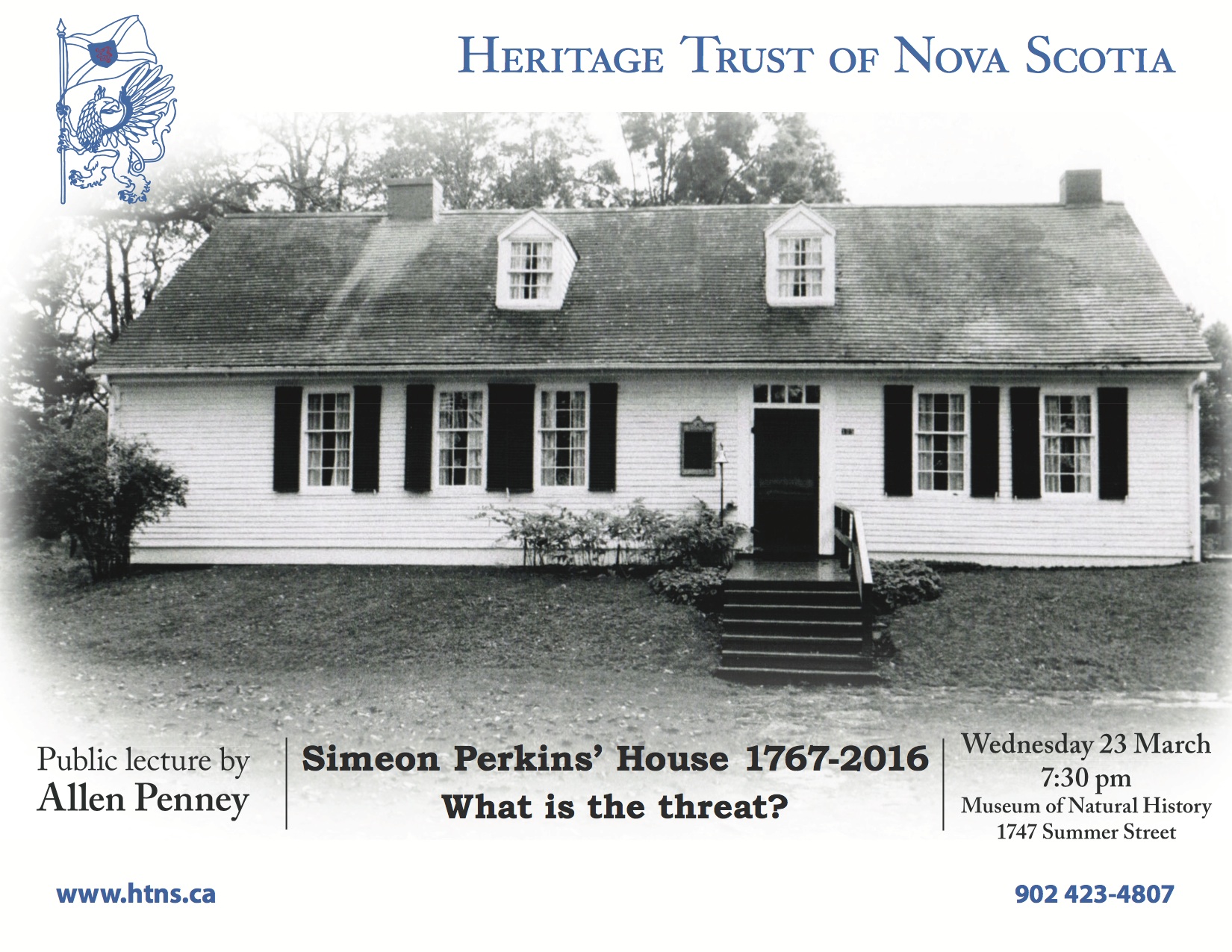
Main Floor Gallery (entrance from side door parking lot) Simeon Perkins' House 1767-2016
|
|||||
HTNS Illustrated Public Lecture Series
Museum of Natural History Auditorium,
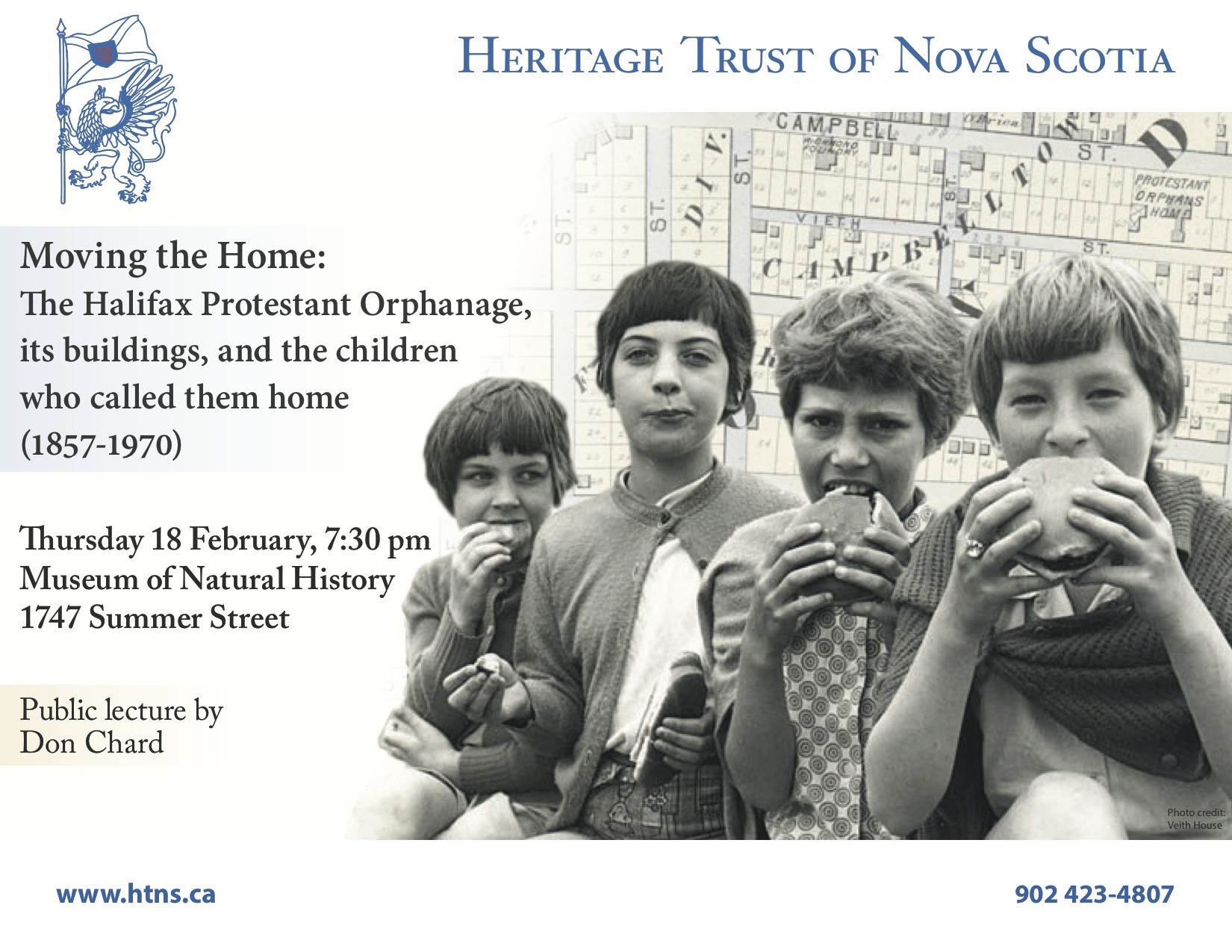
Moving the Home:
|
|||||
Museum of Natural History Auditorium,
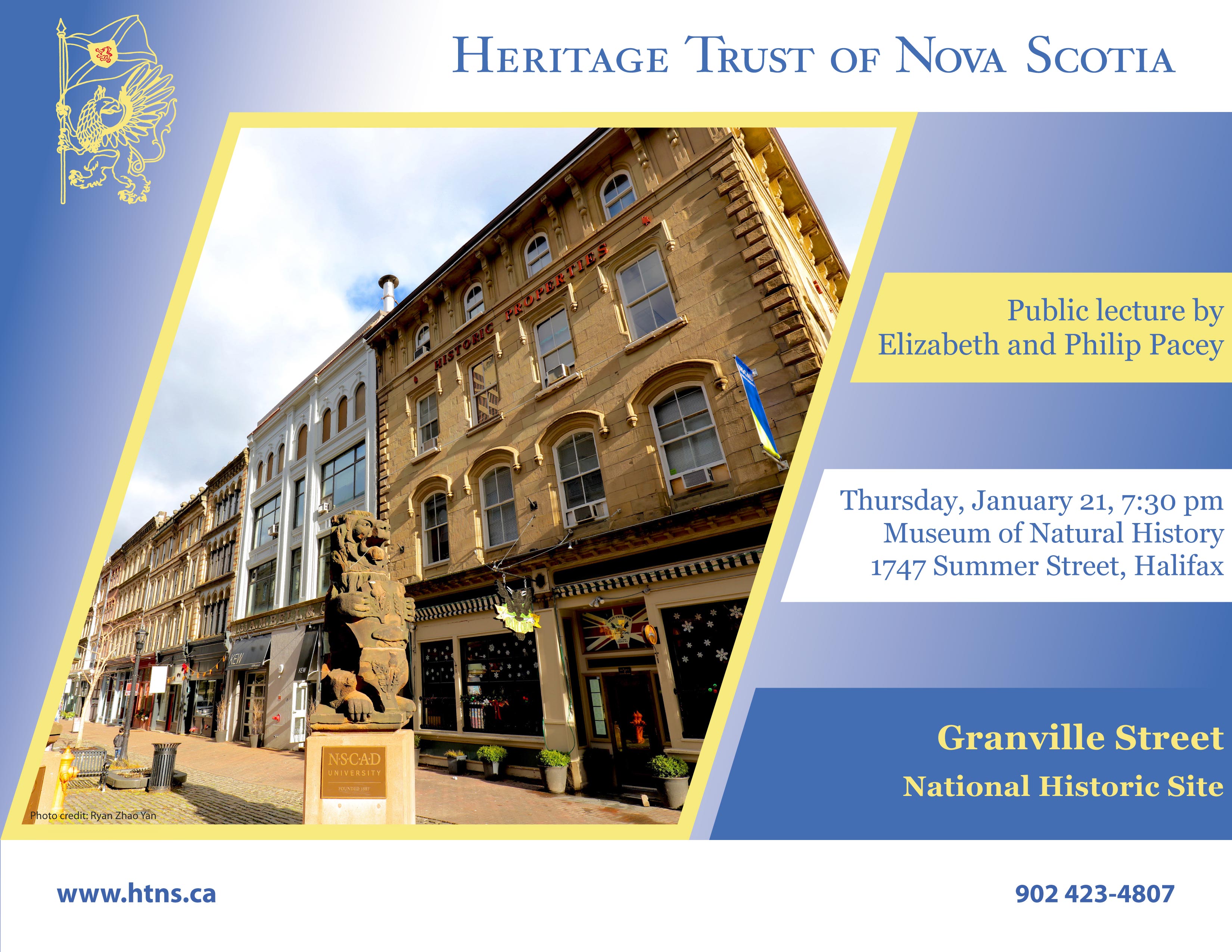
Granville Street – National Historic Site:
|
|||||
Museum of Natural History
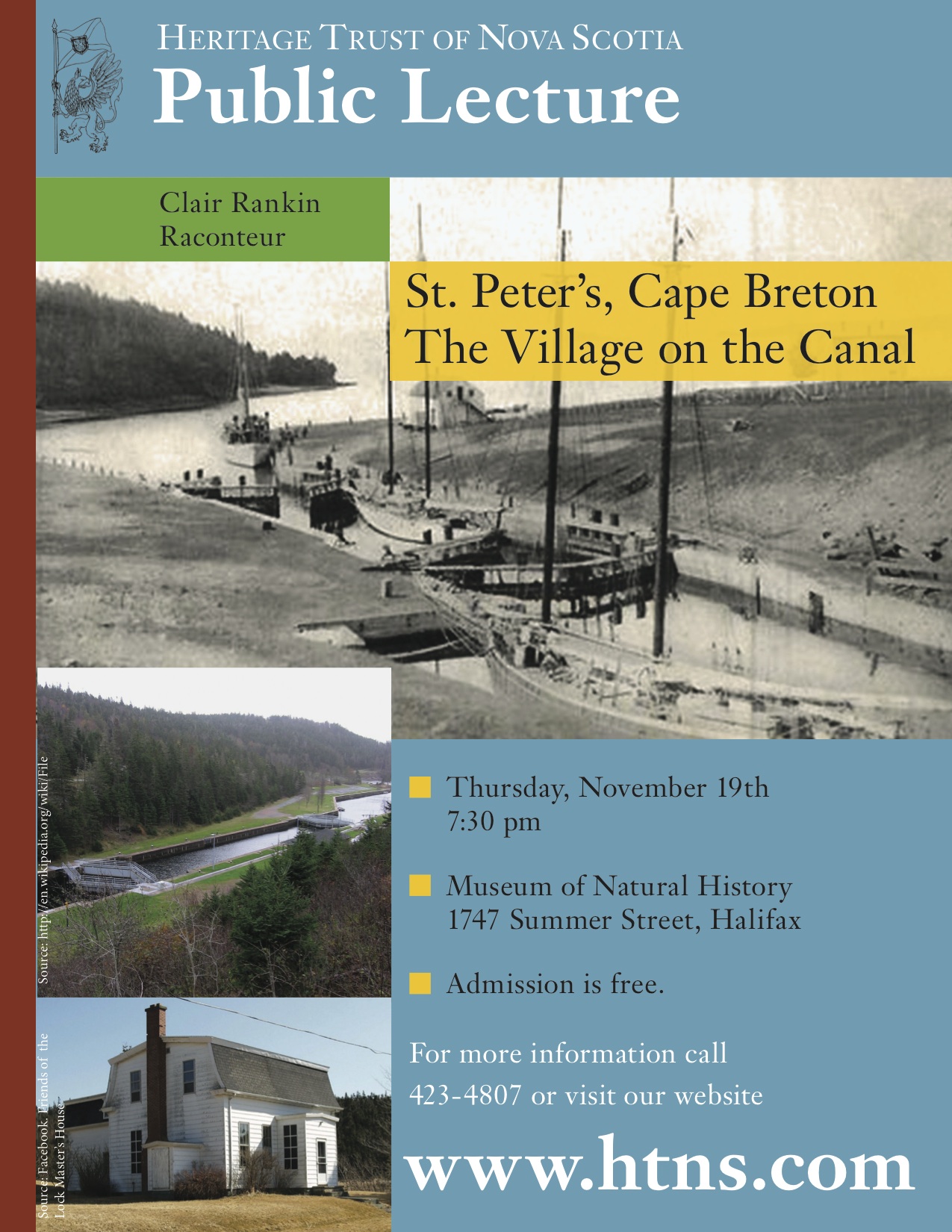
St. Peter's, Cape Breton -
|
|||||
Museum of Natural History Revealing Historic Sinclair Inn's Painted Room in Annapolis Royal
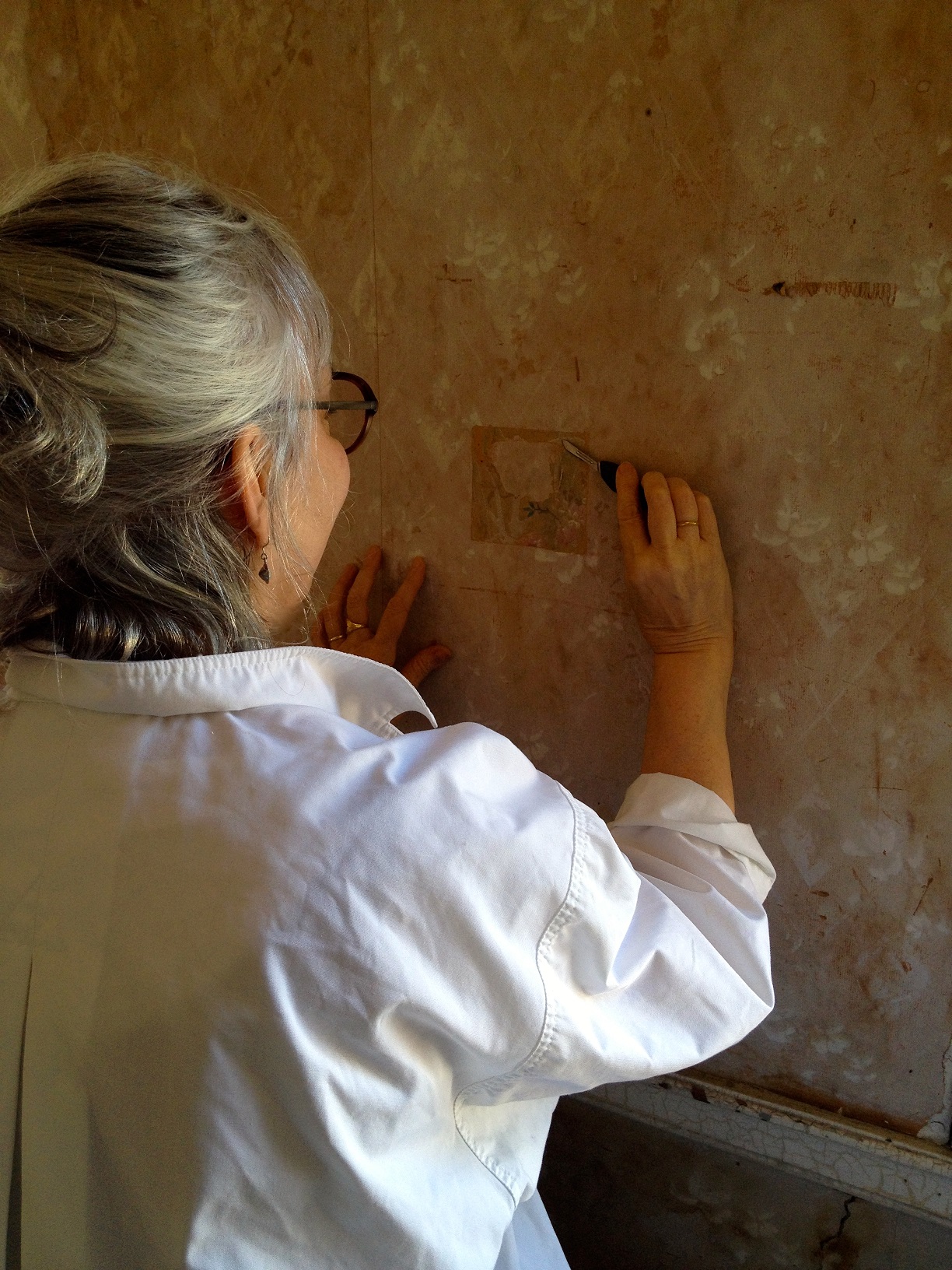
Ann Shaftel will present her findings into hidden wall murals found in one of Canada's oldest buildings. "This is a significant find of national importance," says Ms Shaftel. "The Sinclair Inn is over 300 years old; it is the oldest surviving Acadian building in Canada. My research indicates that the wall murals hidden behind a century of wallpaper were likely painted about 175 years ago." 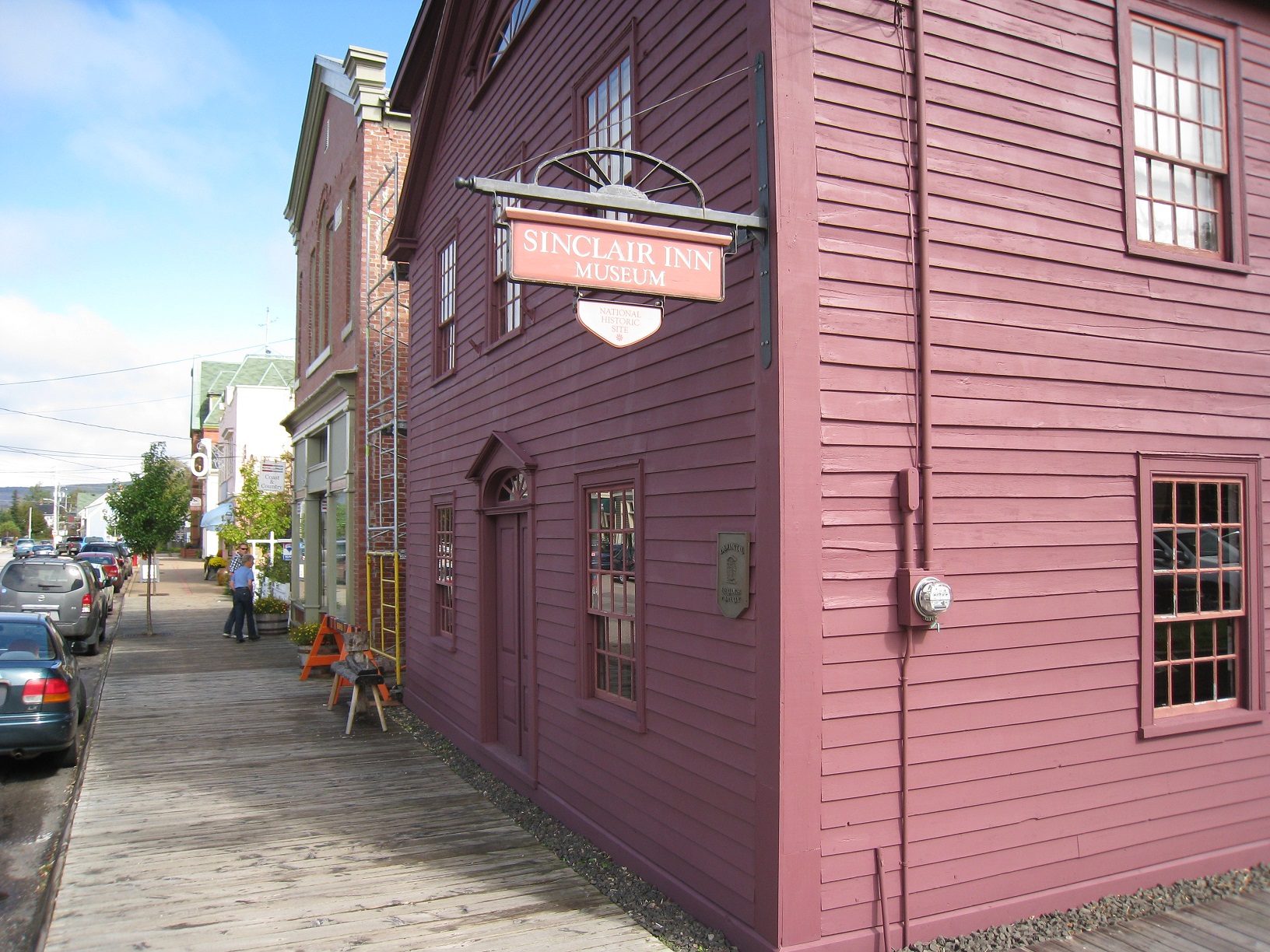 Sinclair Inn – Canada's oldest surviving Acadian home (photo credit: Wayne Morgan Sinclair Inn is a National Historic Site built in 1710. Originally there were two Acadian homes on the lot. One of them was converted to a 'public house' in 1747. Thirty-five years later, it was expanded to include both houses and became known as the Sinclair Inn. Evidence that there might be a painted room in the Sinclair Inn was first noticed in the 1990s when the Annapolis Heritage Society purchased the building. Water damage from a leaky roof in an upstairs room caused the wallpaper to peel. Underneath was evidence of a wall mural. In 2012, members of the Canadian Conservation Institute inspected the building and confirmed that images were hidden under most of the wallpaper. 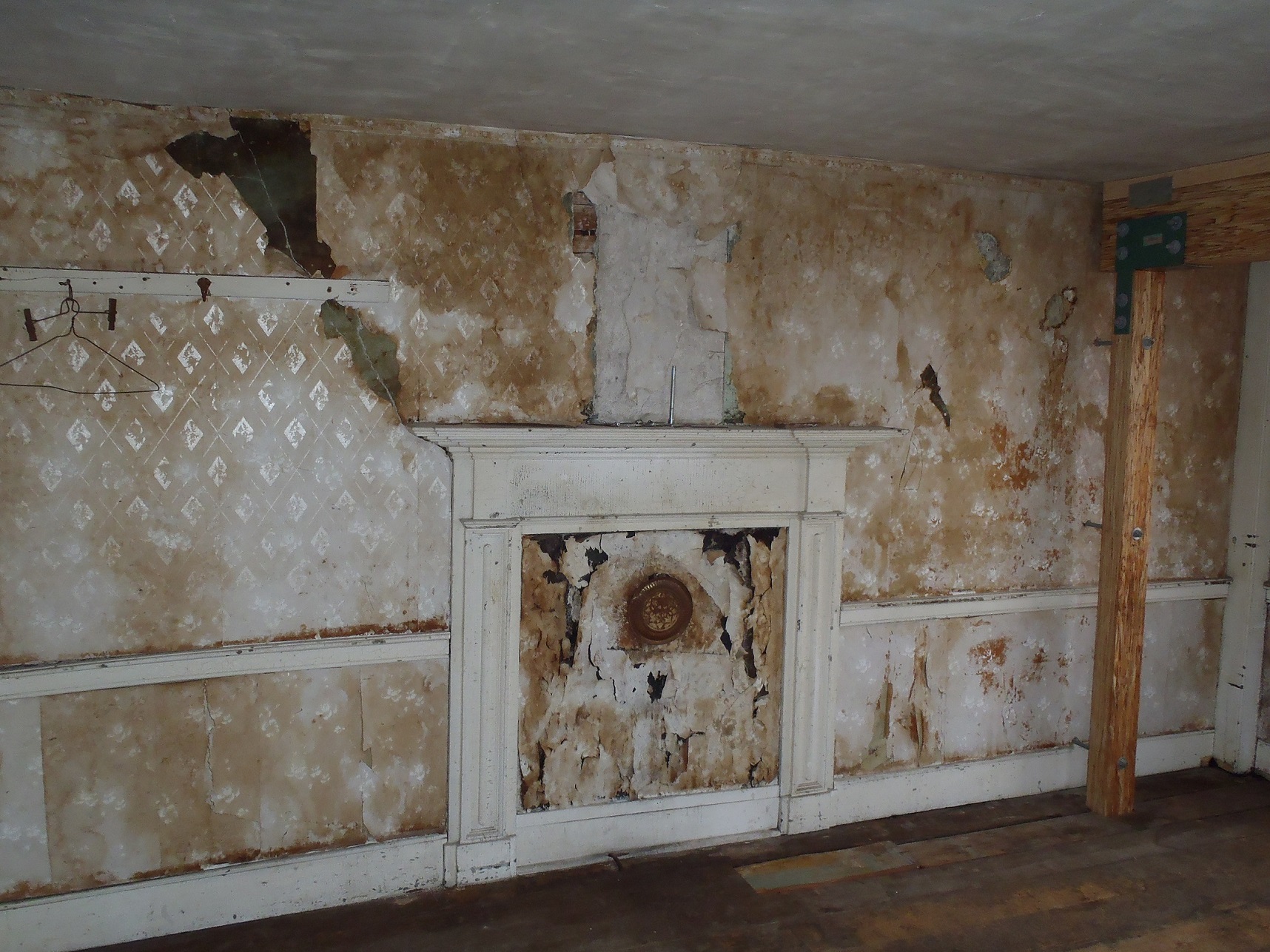 Upstairs room of Sinclair Inn hides 175 year old wall mural (photo credit: Sefton Squires) In 2014, with funding from donors, including Heritage Trust of Nova Scotia, the Annapolis Heritage Society hired Ann Shaftel to further examine the room. Ann holds advanced degrees in art conservation and art history and works for museums, governments, universities, churches and private clients worldwide. One of her other projects was the recent restoration of the Daniel O'Connell 'The Liberator' banner crafted for the Charitable Irish Society in 1875 for use in parades and celebrations. Ann's reveal of some of the hidden wall murals and further research concluded that the Sinclair Inn's Painted Room should be preserved and restored. The Annapolis Heritage Society will be seeking grants and donations to cover the cost of stabilizing the building and restoring the room. The Sinclair Inn is not the first historic Nova Scotia building to reveal a painted room. The most famous is the Croscup Room discovered in Karsdale near Annapolis Royal. In 1976, the Croscup Room was dismantled and moved to Ottawa where it is now displayed in the National Gallery of Canada. For more information on Painted Rooms, visit Heritage Trust's database listing of painted rooms found in Nova Scotia www.htns.ca/paintedrooms. Admission to this lecture on the Sinclair Inn's Painted Room is free and all are welcome! |
|||||
Museum of Natural History Note that due to the Food Truck event in the main parking lot, those attending the Heritage Trust presentation can park in the staff parking lot on the north side of the museum facing Bell Road. Exploring a Victorian Pleasure Ground in Truro
Truro's Victoria Park was established in 1887 as a Victorian Pleasure Ground to highlight the natural wonders of the Lepper Brook Gorge. Joe Ballard, President of Heritage Trust and a senior interpreter with the cultural resource firm, Vineberg & Fulton Ltd., will speak about his recent cultural resource survey of this unique park in the heart of Truro. "Victoria Park is what historians like to refer to as a cultural landscape. While the physical 'landscape' (the eastern hemlocks, the paths and watershed) has been relatively maintained, the 'cultural' component has largely been ignored and forgotten," says Joe Ballard, President of Heritage Trust. Victoria Park has faced development pressures, changing tastes, and a loss in the collective memory about its place as a Victorian park. Once described as a "picturesque panorama of mountain and glen," the 400 ha Victoria Park was the highlight of visits to Truro by many travellers over the centuries. Joe Howe visited the park in 1829 and described the 50-foot Truro Falls (later named Joe Howe Falls) eloquently in the following passage: "Lay thee down upon that rock, my gentle traveller, which the heat of the noon-day sun has warmed, despite the coolness of the neighboring waters – and there, with thy senses half lulled to forgetfulness by the murmurs of the falling stream – thy eyes half closed – and thy spirit all unconscious of earthly turmoils and care – give thyself up to musing, for never was there a more appropriate spot than the Truro Falls for our old men to see visions, and our young men to dream dreams." 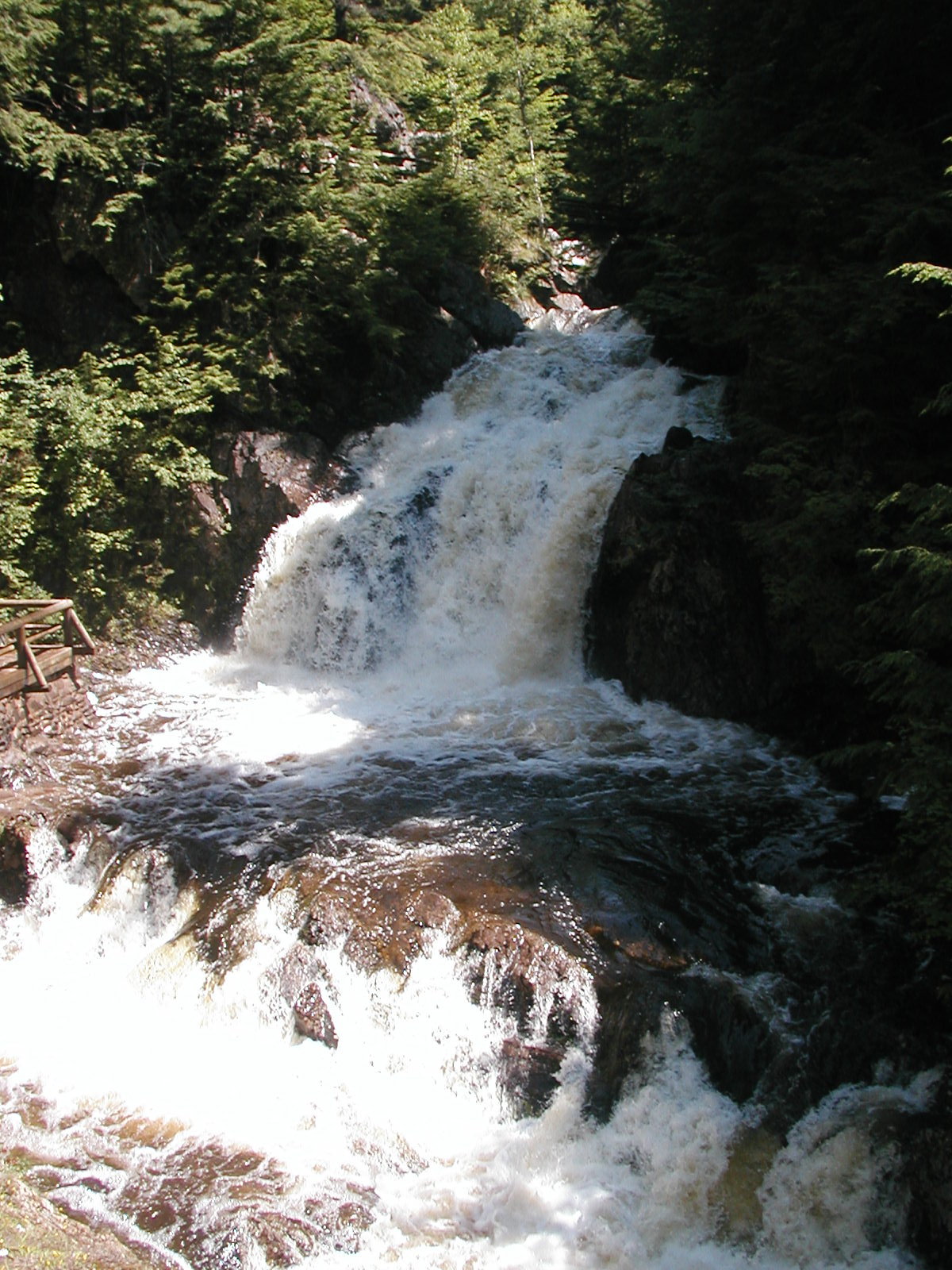 Joe Howe Falls, Victoria Park, July, 2010 (photo credit: Joe Ballard) Victoria Park still features many of the attractions that led to the establishment of the park in 1887. Jacob's Ladder, the staircase that ascends up the side of the gorge, and several of the resting places along the climb are still popular with visitors. However many of the other Victorian attractions have disappeared over time. In 2012, the Town of Truro issued a request for proposals for a comprehensive cultural resource study of Victoria Park. Mr. Ballard will discuss findings of this cultural study, identify the factors that threatened the historic landscape and reveal what it is that makes Victoria Park one of Nova Scotia's most unrealized tourism assets. Admission free—Everyone welcome! |
|||||
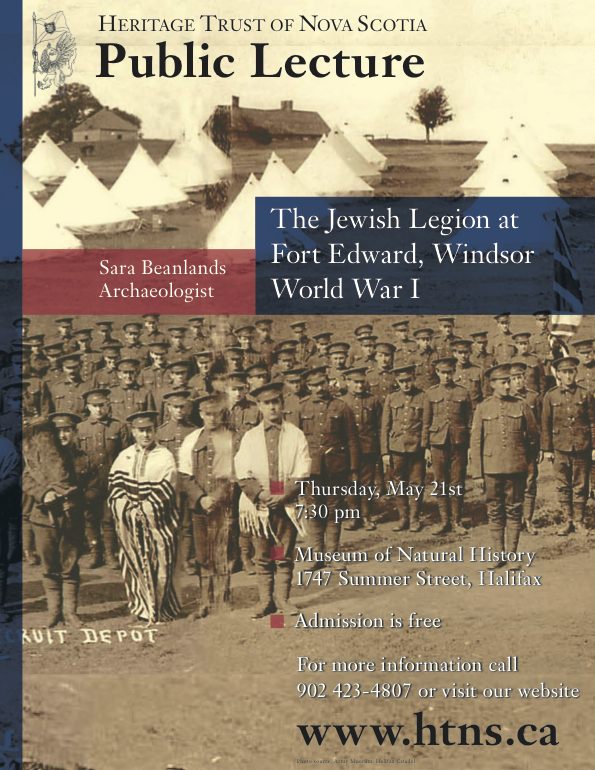
Museum of Natural History The Jewish Legion at Fort Edward, Windsor World War I
Sara Beanlands, will give a public talk on the little-known subject of Nova Scotia's connection with the British army's Jewish Legion that trained at Fort Edward, Nova Scotia during World War I. David Ben-Gurion, who became the first prime minister of the new state of Israel in 1948, was a member of the Legion. Ben-Gurion, along with hundreds of other Jewish men, trained in Nova Scotia before going to England for further training. Their mission was to liberate Palestine from Turkish rule during World War I. Sara Beanlands is a Principal and Senior Archaeologist with Boreas Heritage Consulting Inc., specializing in cultural resource management. Graduating from Dalhousie University with a Bachelor of Arts in History and Anthropology in 1998, and completing a Master's degree in History at Saint Mary's University in 2010, Sara has worked extensively throughout Nova Scotia, Newfoundland and Labrador, and in Ontario. Her work has been published in the Journal of the Royal Nova Scotia Historical Society, the International Journal of Maritime History and the University of Edinburgh Journal. She has served as President of the Nova Scotia Archaeology Society and currently sits on the Board of Directors of the Archaeological Land Trust of Nova Scotia and the Royal Nova Scotia Historical Society. She is also a Part-time Professor in the Department of Anthropology at Saint Mary's University. Admission free—Everyone welcome!
|
|||||
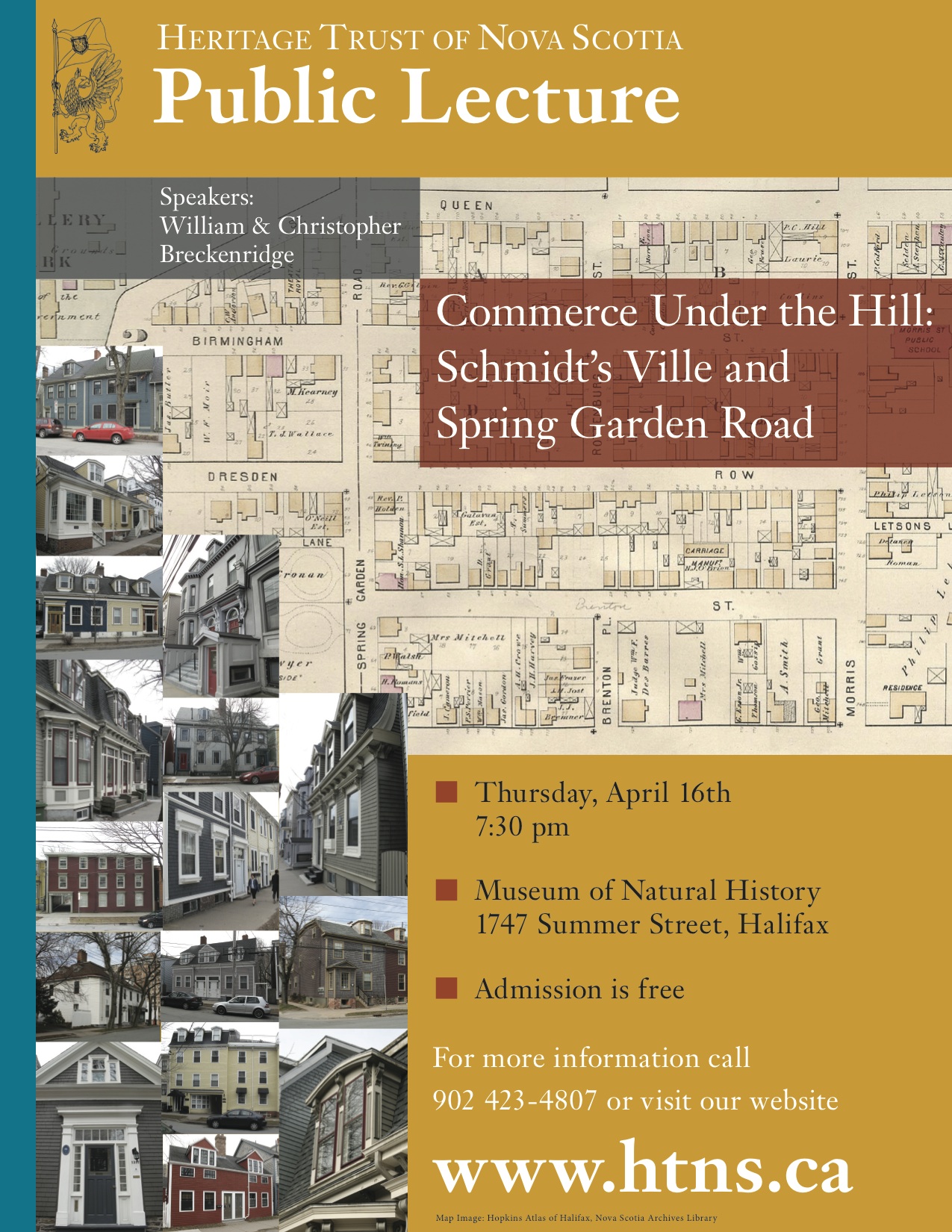
Museum of Natural History Commerce Under the Hill: Schmidt's Ville and Spring Garden Road.
|
|||||
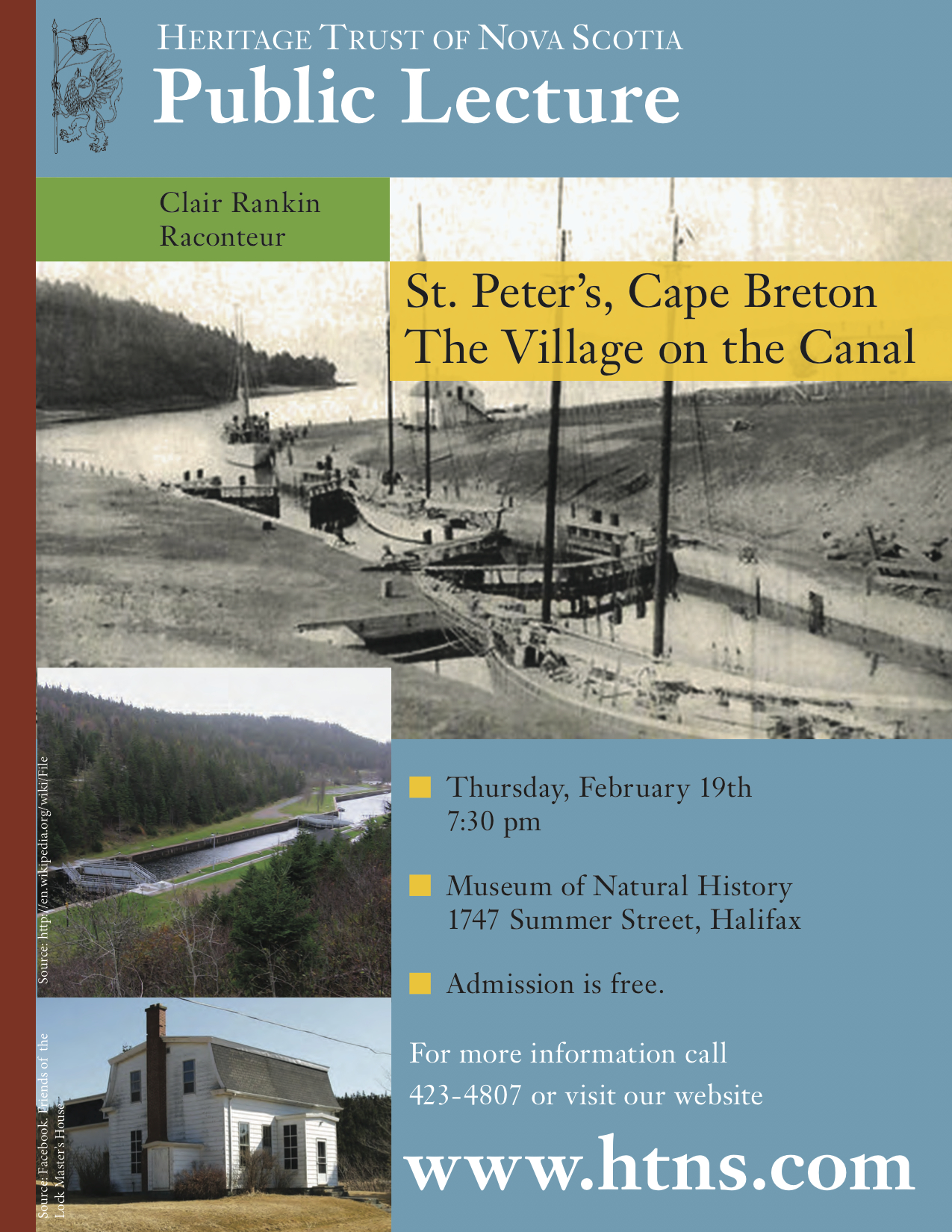
Museum of Natural History St. Peter's, Cape Breton—The Village on the CanalFor 10,000 years, the Mi'kmaq traversed the isthmus that separated the Bras d' Or Lake from the Atlantic Ocean. Later, the first Europeans built a marine railway to haul their boats across this isthmus. Home to three forts which witnessed seven battles for ownership, St. Peter's was an integral ingredient in the emergence of this great country, Canada. When the St. Peter's Canal was opened in 1869, a new era of prosperity and community spirit dawned on the Village. Almost a century and a half later, St. Peter's remains a vibrant commercial, cultural and recreational centre for Richmond County and to any visitors to the beautiful island of Cape Breton. Join St. Peter's native and local raconteur, Clair Rankin, for an evening through time and timber as he presents the history of this storied shore. Clair Rankin is fortunate to be a life-long resident of St. Peter's. His civic pride is reflected in his past and present activities such as 10 years as the county councillor for the area, a 25 year member of the St. Peter's Volunteer Fire Department and 30 year member (and 6 years as Chair) of the St. Peter's Community Club, the oldest community service club in Richmond County having been in existence since 1953. The Community Club also operates the Nicolas Denys Museum, the largest museum in Richmond County. His interests are varied, but his focus is clear. St. Peter's is a fabulous place to call home. Admission free—Everyone welcome!
|
|||||
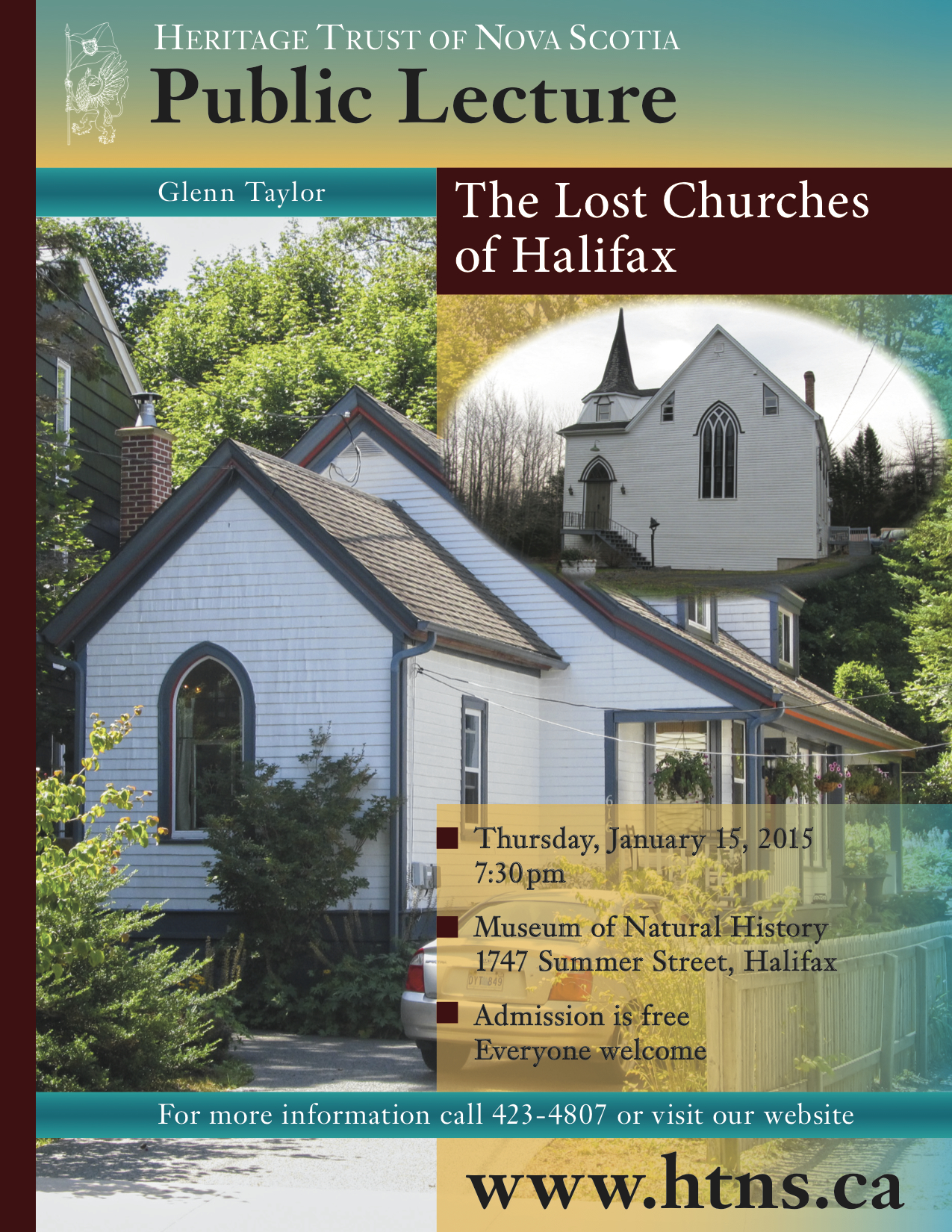
Museum of Natural History The Lost Churches of HalifaxFor over 250 years churches have been built in Halifax County. Churches have also been abandoned, burned down, blown up, sold or, to use a more modern term—repurposed. Many churches and synagogues too have simply disappeared—in most cases buried under a new office tower or housing development. There are, however, many churches that still stand as homes, businesses, museums, and daycares. Haligonians and visitors to our city pass by such churches on a daily basis in many cases oblivious to their existence. They are for all intents and purposes ...lost. Glenn Taylor has been out looking for these lost churches and to date has found over thirty-five of them with the stories they can tell us...if we take the time to listen. The churches represent the aspirations of the congregations that built them. It is fascinating to reflect on the joy, the sorrow, the struggles and the accomplishments of those congregations during the years they worshipped in their churches. Now those stories lie silent, as silent as the buildings themselves. Glenn Taylor retired in 2006 after 34 years with the Halifax District School Board. He began his career at Alexandra School on Brunswick Street as a classroom teacher and ended his career as principal of Elizabeth Sutherland School in Spryfield. After retirement Glenn has pursued opportunities associated with his passion for history. He is actively engaged as a tour guide and often speaks to students in schools on heritage subjects. Glenn is a member of the Heritage Trust, the Friends of the Public Gardens, the Nova Scotia Heritage Fair Board and is president of the Rockingham Heritage Society. In 2005 he co-authored the musical 'Skyhawk' which was nominated for an East Coast Music Award. He enjoys researching and writing on various aspects of Nova Scotia's past. His interest in decommissioned churches is the latest of those interests. Join members of Heritage Trust at their January meeting to learn more about the Lost Churches of Halifax. Admission free—Everyone welcome!
|
|||||
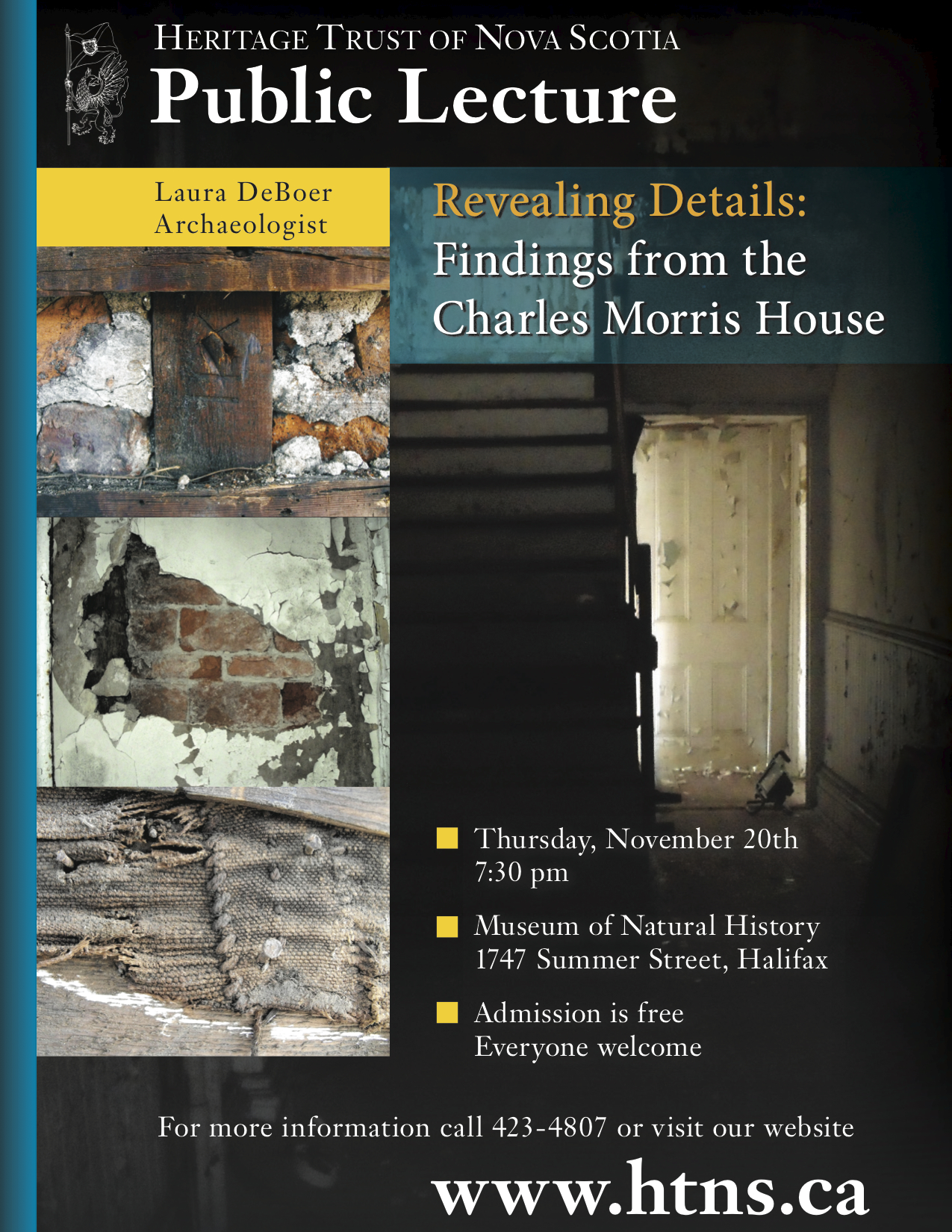
Revealing Details: Findings from the Charles Morris HouseAs one of Halifax's oldest buildings, Charles Morris' historic house has seen a varied and colourful history including two relocations and a variety of reuses. Thanks to work by the Heritage Trust many are now familiar with the documented history of the building. There is even more to be learned, however, from the building itself. Marked by small fires, deposits of historic clothing, carpentry and marriage marks, blocked windows and doors, and layer upon layer of wallpaper, the physical evidence of the structure can be used to piece together even more detail of its life and its renovations. To many of us, no building is more interesting than a building that shows signs of changing times, and a walk though the former office of Charles Morris is proof of this. Laura de Boer is an archaeologist at Davis MacIntyre & Associates Archaeological Consultants. She holds a Master's degree in European Historical Archaeology from the University of Sheffield and a B.A. in Anthropology from Saint Mary's. Laura has been involved in archaeological field survey since 2006, and began working in the consulting field in 2008. She specializes in the archaeology of industrialization and in standing building archaeology. Admission free—Everyone welcome!
|
|||||
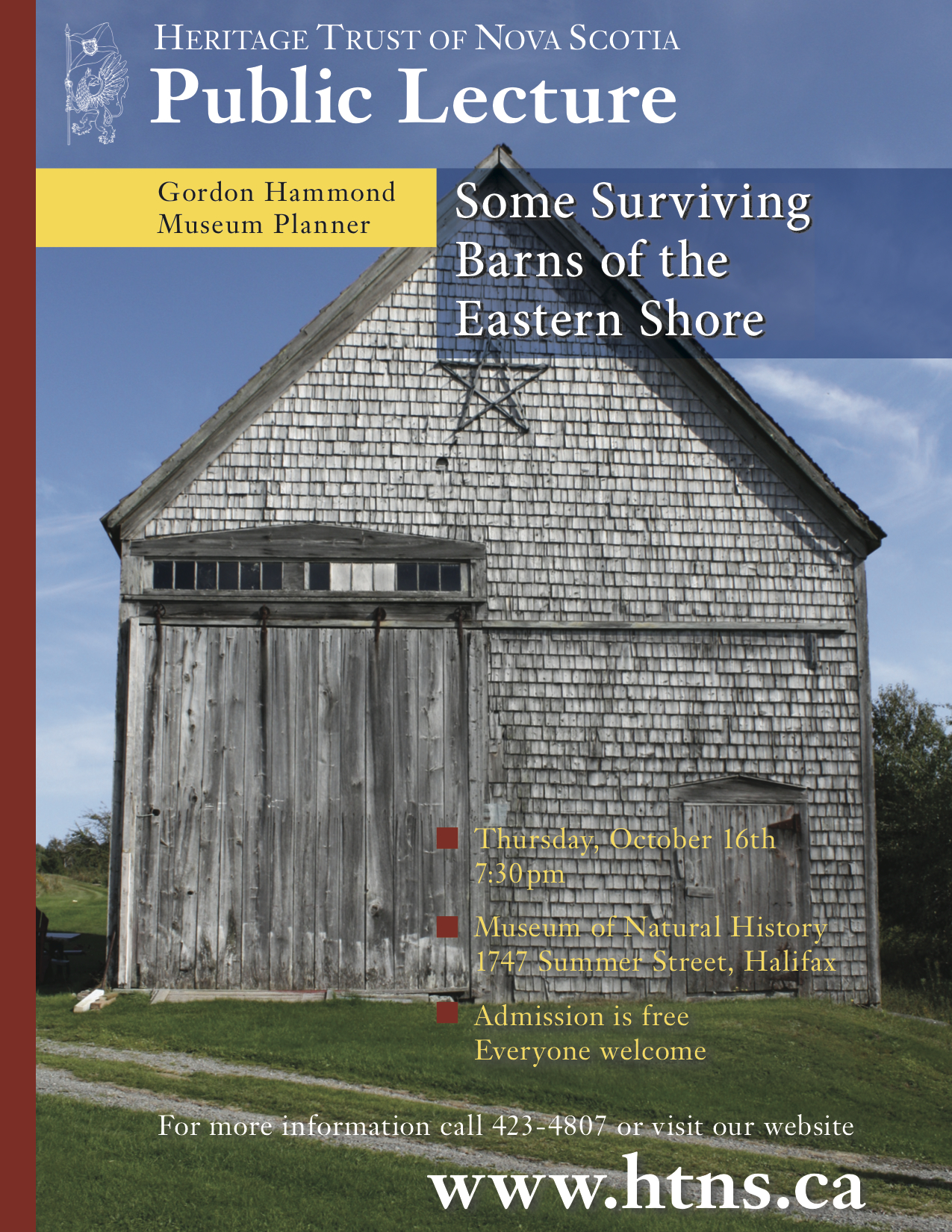
Some Surviving Barns of the Eastern ShoreGordon Hammond, a semi-retired museum planner, is a key player in the ongoing development of Memory Lane Heritage Village on the Eastern Shore, recently nominated by an international tourism consultant as one the dozen best museums in Nova Scotia. Part of the Village's success flows from its commitment to authenticity in the restoration, preservation and interpretation of the Village's buildings. This commitment to authenticity requires sound research whenever possible and was one the of the motivations for documenting the surviving barns of the Eastern Shore. The other motivation was a growing awareness that many older barns were vanishing as they were either blown down, torn down or collapsed. Mr. Hammond's talk will focus on the fifty or so barns from Ecum Secum to Myers Point that he has documented to date, approximately half of the surviving barns between Ecum Secum and Lawrencetown. Admission free—Everyone welcome!
|
|||||
HTNS Places of Worship Committee Public Lecture
|
|||||
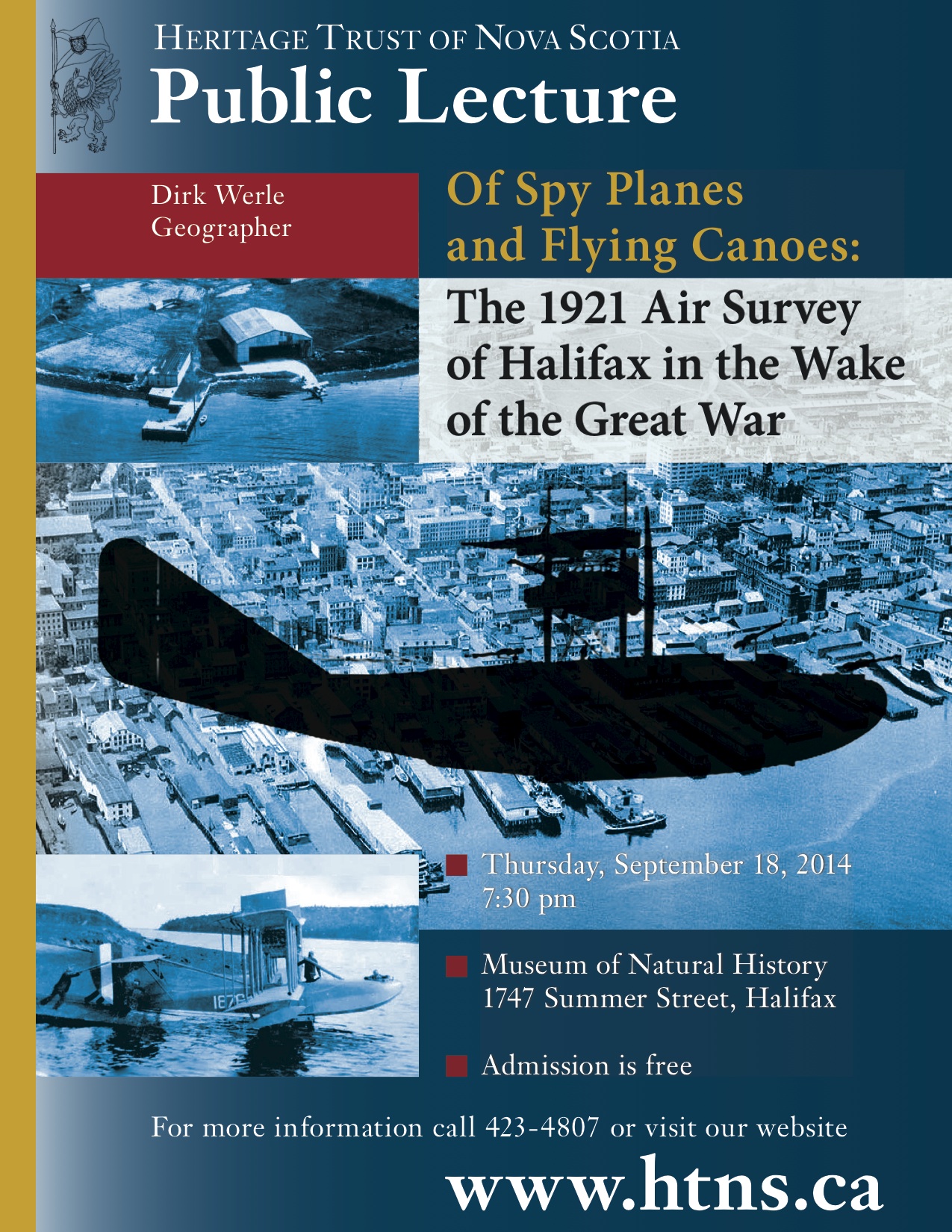
Of Spy Planes and Flying Canoes: The 1921 Air Survey of Halifax in the Wake of the Great WarThe lecture is an offshoot from research into the military and civilian history, technological development, and practical outcomes of aerial photography in Canada after the First World War. An episode of one of the first urban surveys, carried out over parts of the Halifax peninsula in 1921, is highlighted. Using the photos and a re-assembled mosaic as a guide, a variety of features unique to the post-war urban landscape of the city are illustrated and discussed. Dirk Werle is a geographer and managing partner with Ærde Environmental Research in Halifax. He has worked as a researcher and advisor to Canadian government agencies for almost 30 years, often with focus on the utilization of modern Earth observation satellites. He is a past president and associate fellow of the Canadian Remote Sensing Society and serves on the board of the International Ocean Institute – Canada.
|
|||||
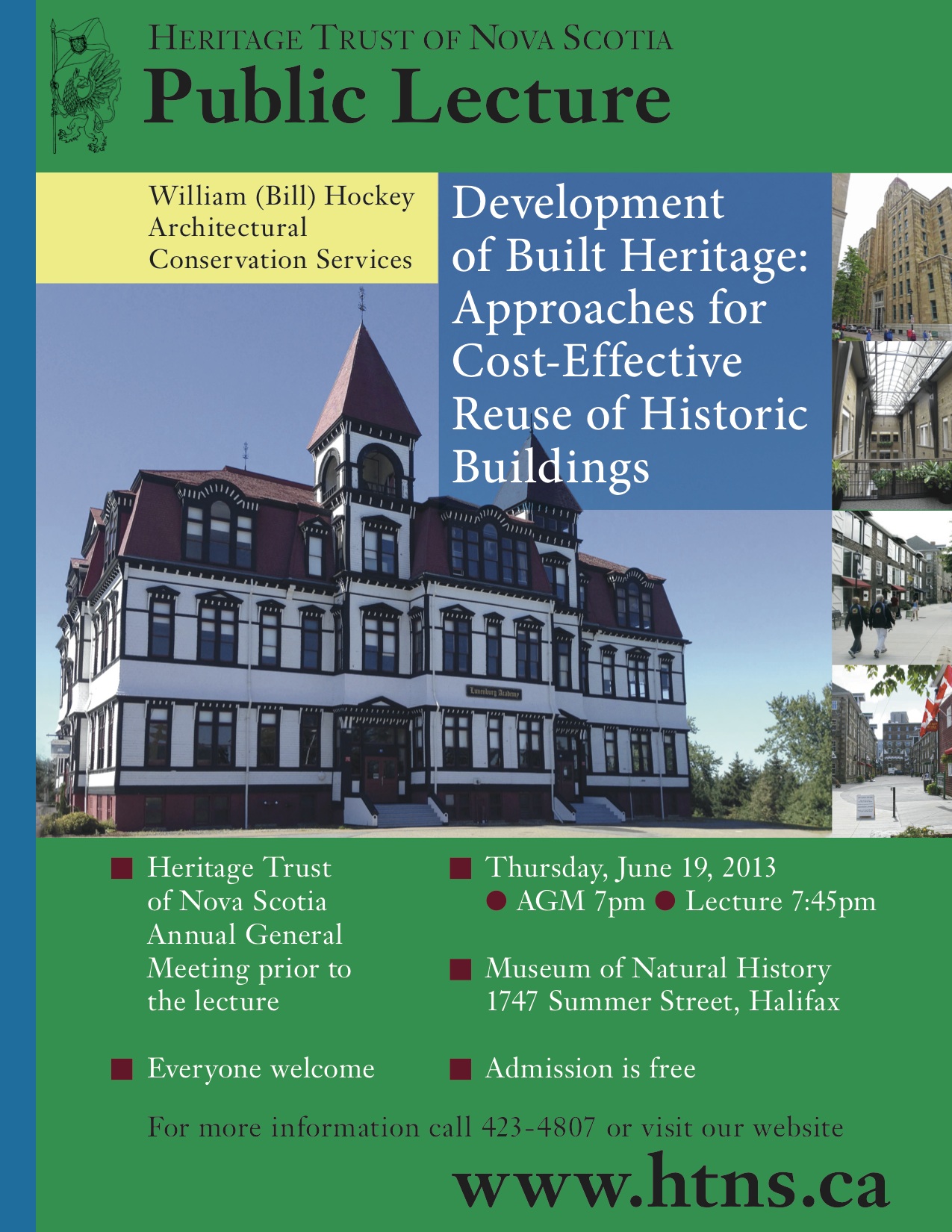
W.B. (Bill) Hockey, B. Arch., MEDS(conservation), CAHPMr. Hockey received his Bachelor of Architecture in 1970. He has been working in the preservation field since September 1971, when he was hired by Parks Canada to produce measured drawings of Historic Properties, Halifax as part of their commitment to assist with development of the site. He moved to Ottawa in 1974 where he held positions in Heritage Recording and Restoration Architecture. While there he worked on historic sites from coast to coast, as well as sites in Dawson City, Yukon. In 1979 he moved to Calgary to become Head of Restoration Architecture, responsible for projects in Alberta and British Columbia. In Alberta Mr. Hockey was a member of the Alberta Association of Architects and the Alberta Building Envelope Council, (ABEC). He also took responsibilities as Project Manager for projects including Renovation of Big House, Fort Langley, Rehabilitation of the Banff Park Museum, and stabilization of the Gulf of Georgia Cannery in Richmond, B.C. It was through work on these projects plus his involvement with ABEC, that he became interested in both the costs and technical problems related to the continued use of historic buildings as a cost-effective alternative to new construction. In 1988 Mr. Hockey returned to Halifax as Head Architectural Analysis and Planning for the historic and contemporary buildings portion of the Parks Canada Agency's Program in Atlantic Canada. He also pursued a Master of Environmental Design Studies (Conservation) Degree, receiving it in 1992. His Thesis evaluated the costs of reuse of historic buildings and how they are incurred, using 54 Canadian Case Studies as the statistical basis for the study. Between August 4, 1993 and October 31, 2001 Mr. Hockey dealt with the ravages of fire for St. Andrew's Blockhouse, Saint George's Round Church, Halifax, the Pictou Railway Station, Green Gables House, and St. John's Anglican Church, Lunenburg, building expertise in a field that he had not intended to work in. Mr. Hockey also provided certification services with the Canadian Heritage Places Incentive Funding Program reviewing projects for compliance with the Standards and Guidelines for the Preservation of Historic Places in Canada. He also served on the national committee that reviewed Conservation Master Specifications for the NMS Secretariat. Mr. Hockey retired from the Federal Government in December 2006 and currently offers consultant services through his company Architectural Conservation Services based in Halifax, Nova Scotia. Through ACS, he has worked with the restoration of historic masonry and maintenance planning, provided FHBRO functional training to Parks Canada Staff, functional guidance for a number of clients, and worked in the lead role for a number of other projects. Review his website: www.archconserve.ca for detailed information regarding this experience. Mr. Hockey is a member of ICOMOS Canada, Heritage Canada, and the Association for Preservation Technology International, (APTI). He is also a Professional member of the Canadian Association of Heritage Professionals www.cahp.ca as a Building Specialist.
|
|||||
Allen Penney presents:
|
|||||
Justin Helm presents:
|
|||||
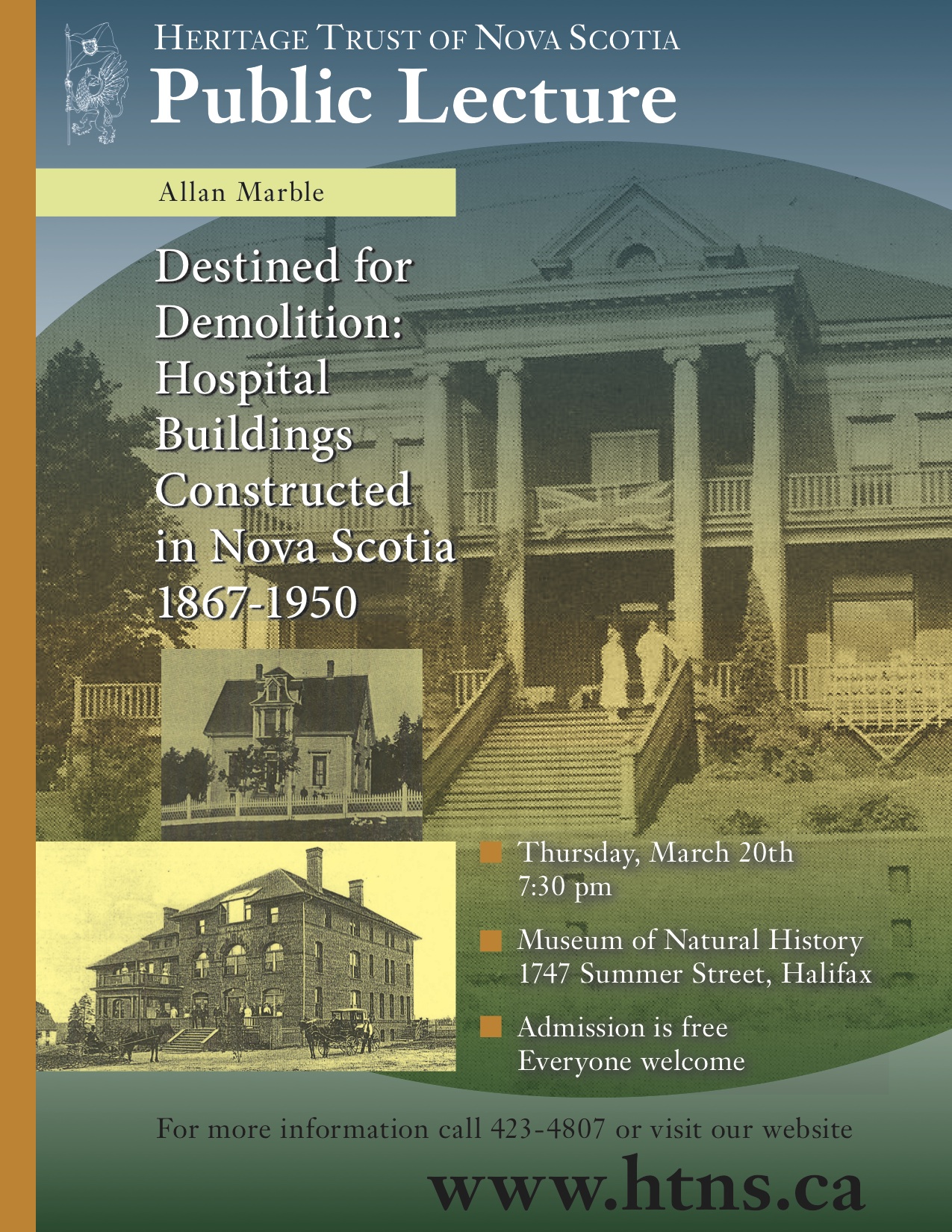
Allan Marble presents:
|
|||||
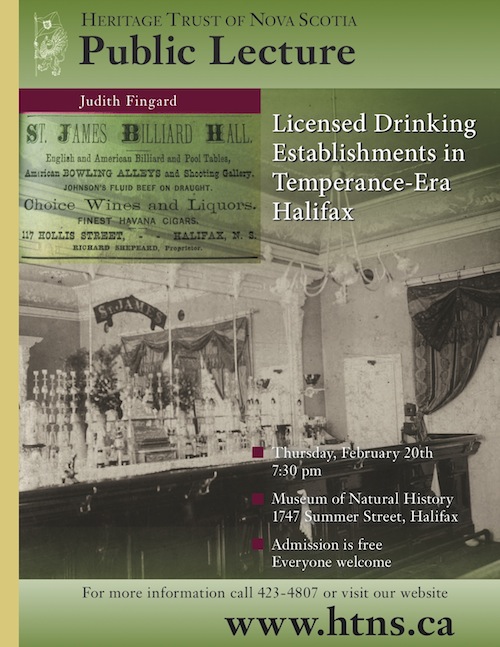
Judith Fingard presents:
|
|||||
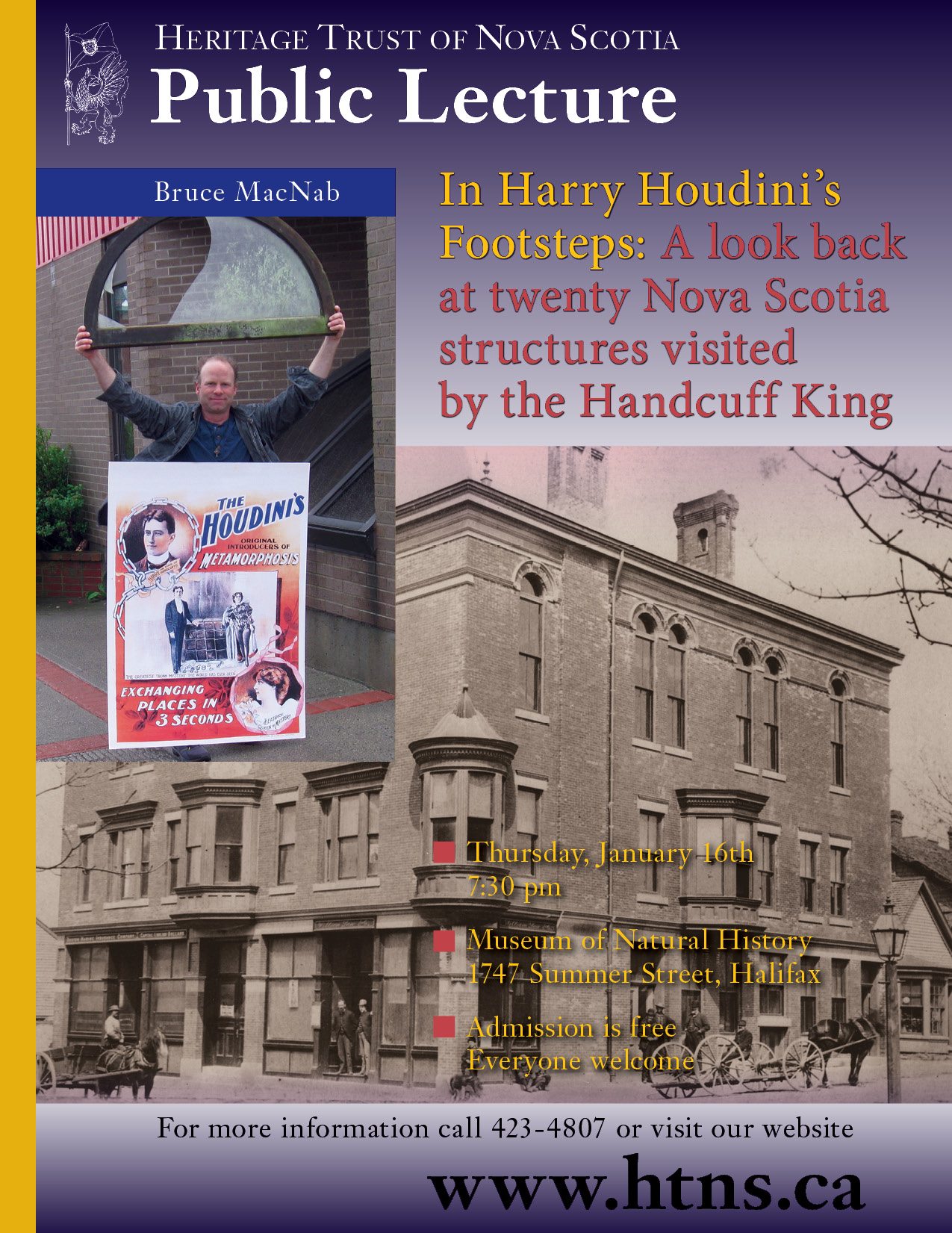
Bruce MacNab Presents:
|
|||||
|
|||||
HTNS Illustrated Public Lecture Series
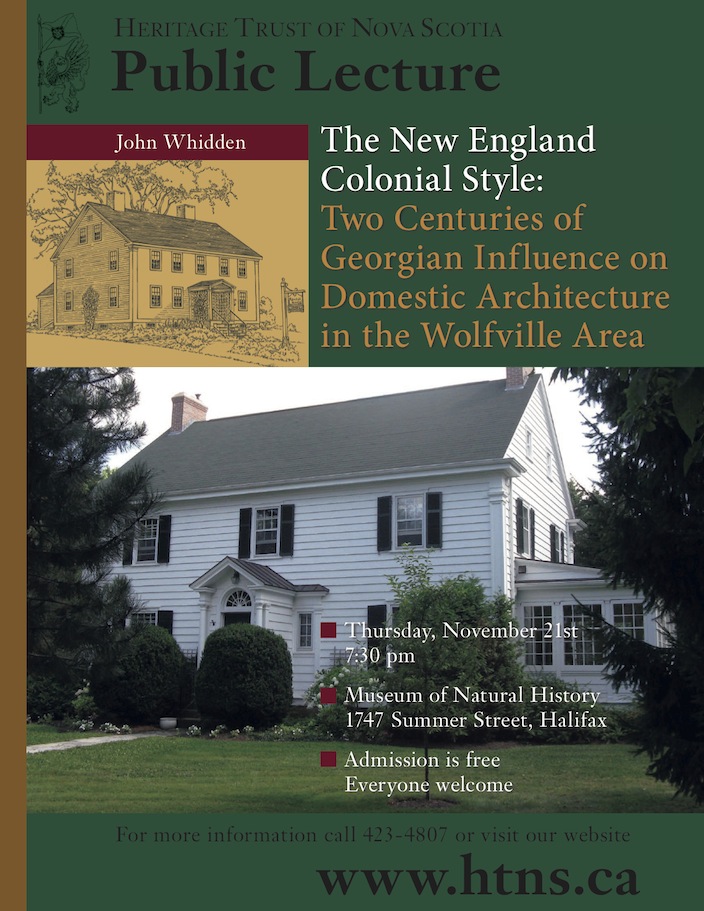
John Whidden presents:
|
|||||
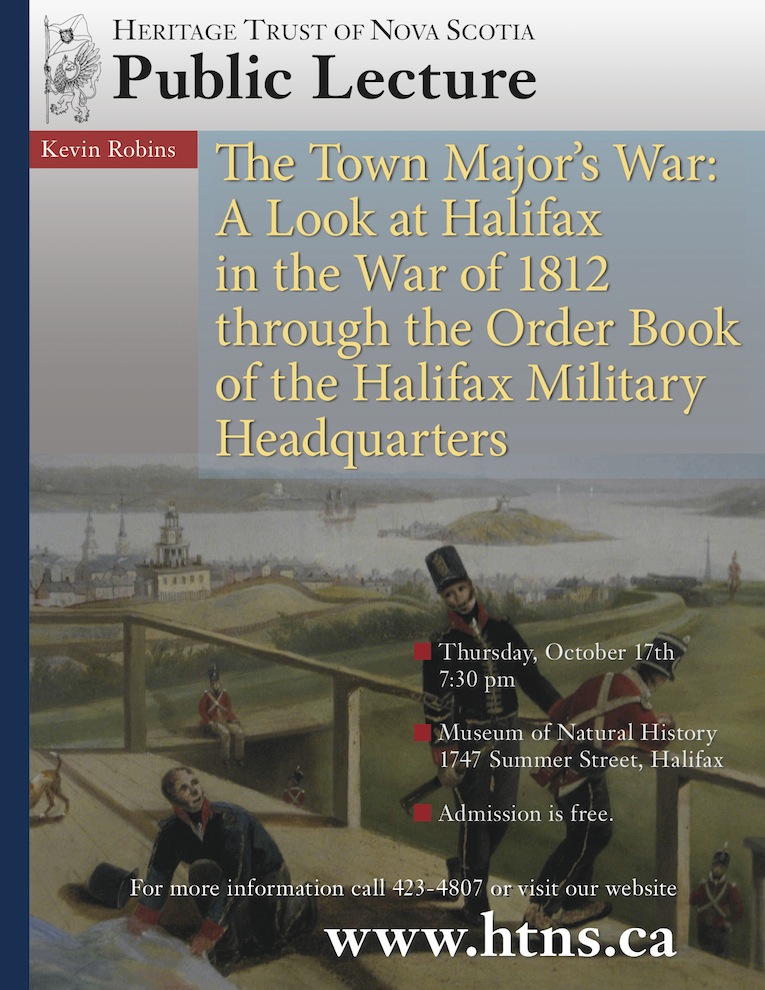
The Garrison Orderly Books for the Army Headquarters in Halifax for the War of 1812 are in the collection of the Nova Scotia provincial archives. The Orderly Books contain entries that allow the researcher to gain a day to day perspective of war in a garrison town during the late Georgian era. Kevin Robins of the Army Museum invites you to join him as he shares some of his findings that illustrate everything from the posting of guards around the city to military justice and supply of garrison, as well as news from abroad and from the battlefields of Upper and Lower Canada. Poster image credit: John Elliott Woolford, View from Citadel Hill, in the collection of the AGNS..
|
|||||
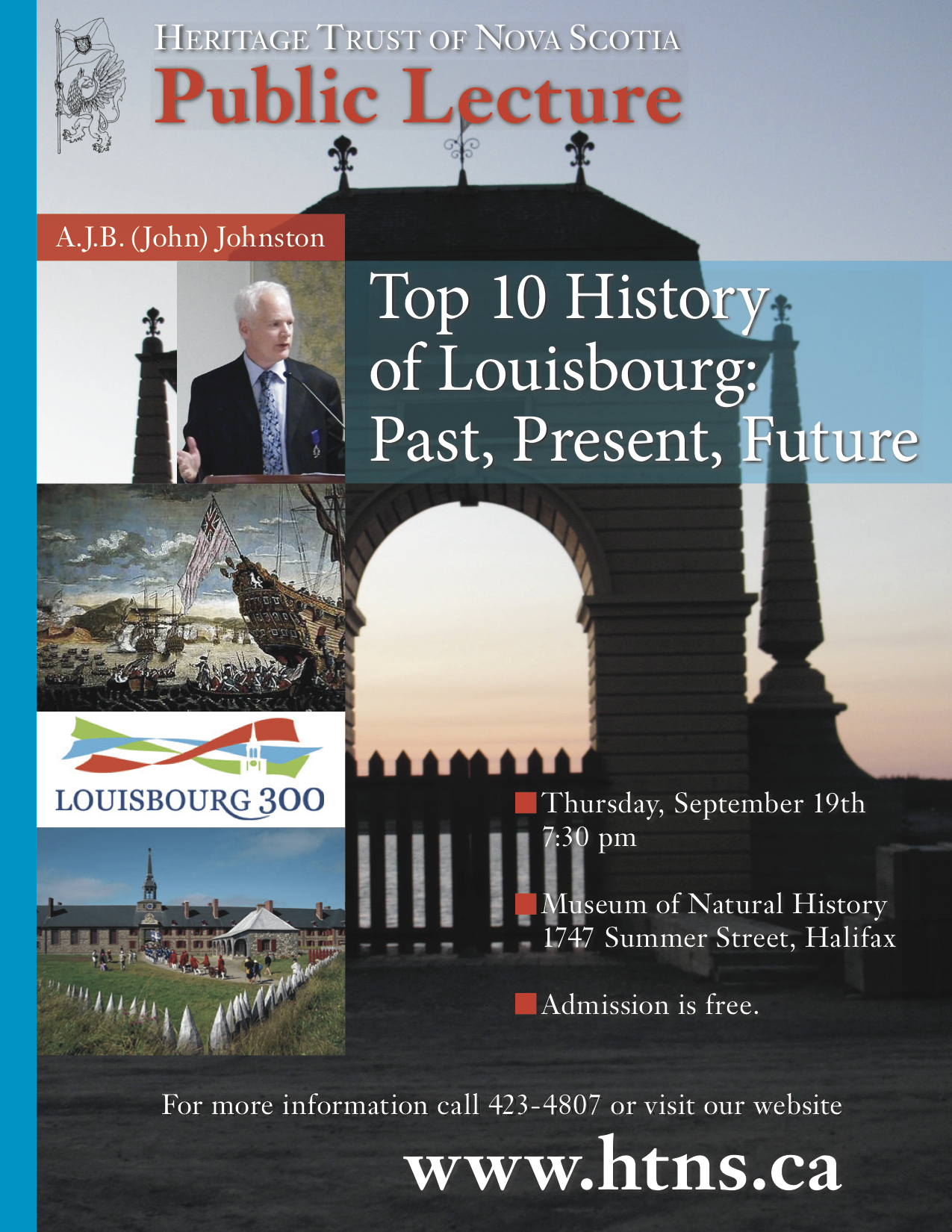
Top 10 History of Louisbourg: Past, Present, Future. By A.J.B. (John) JohnstonThe talk is based on his decades of research and writing about Louisbourg and its 18th-century world. John is the author or co-author of fourteen books; thirteen deal with history and he has one novel so far. Among his most recent books is Louisbourg: Past, Present, Future (Nimbus Publishing). John Johnston was recently made a chevalier of France's Ordre des Palmes académiques in recognition of his body of work. The talk will be very well illustrated. More information on the speaker can be found at AJB Johnston.
|
|||||
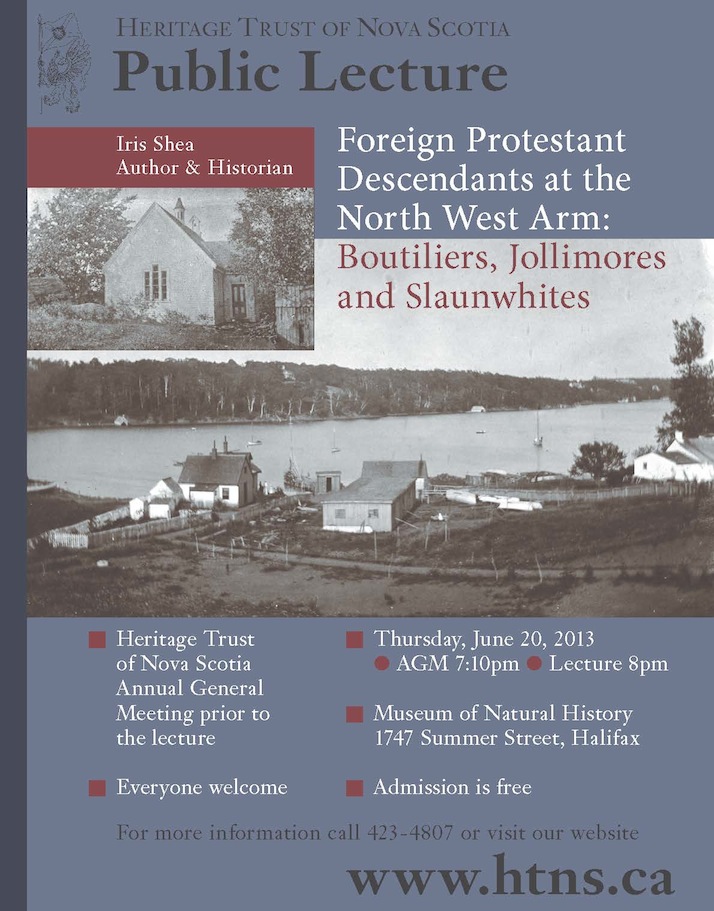
Iris Shea Presents:Foreign Protestant Descendants at the North West Arm; Boutiliers, Jollimores and Slaunwhites. Over the past 25 years Iris Shea has researched the history of the communities from Armdale to Pennant. Jollimore, one of those communities, was first called "North West Arm". The Jollimores were the first permanent settlers to the North West Arm in 1826, followed by their cousins, the Boutiliers and Slaunwhites, all descendants of foreign Protestants. These three families established a thriving community on the western side of the Northwest Arm, working in the local quarries and mills, and building rental cottages on their shoreline property which attracted prominent Halifax residents. Several houses, built well over a century ago, are standing today. Her talk will include images of Jollimore's past and its people. Iris spent the first 18 years of her life in Jollimore where her mother's family settled in 1908. She co-authored Deadman's: Melville Island and Its Burial Ground with Heather Watts and, with Dr. Joyce Hemlow, published three articles on the Umlahs, Hemlows and McDaniels in the Nova Scotia Historical Review. Since 1999 she has been writing a monthly local history article "Discovering Our Past" in the Chebucto News. Admission is free
|
|||||
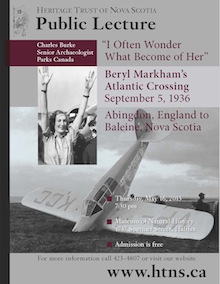
Charles Burke Senior Archeologist of Parks Canada Presents:"I Often Wonder What Become of Her" Lectures take place at the Museum of Natural History, Summer Street, at 7:30 pm (see details at top of page). Admission is free
|
|||||
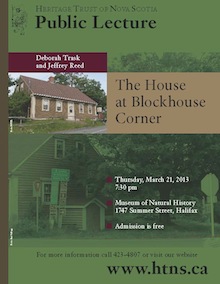
Deborah Trask and Jeffrey Reed will discuss the historic house at Blockhouse Corner, which was moved in June of 2012. The move was documented by a film crew for the HGTV show 'Massive Moves', which aired in February 2013. They will talk about the history of the property, its surroundings and the structure.Deborah Trask spent 30 years on the curatorial staff of the Nova Scotia Museum before her retirement as Curator of Buildings & Operations, at which time the Board of Governors appointed her 'Curator Emeritus'. Since then she started a museum consulting service and managed the Mahone Bay Settlers Museum for 4 years. Jeffrey Reed has served as the Coordinator of the Heritage Property Program, and as Standards and Guidelines Officer for the Province, including a period as the Nova Scotia representative on the National Standing Committee, which oversaw the creation of the second edition of the Standards and Guidelines. Lectures take place at the Museum of Natural History, Summer Street, at 7:30 pm (see details at top of page). Admission is free
|
|||||
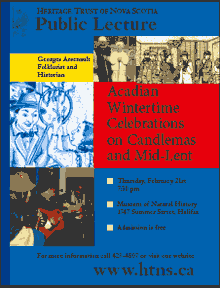
Acadian Wintertime Celebrations on Candlemas and Mid-Lent by Georges Arsenault The well-known Acadian folklorist and historian Georges Arsenault will give an illustrated talk on two ancient and popular Acadian winter celebrations. The first is known as Chandeleur (Candlemas) and takes place on February 2. The second, called Georges Arsenault has researched the origins of these joyful traditions and how they were observed in Acadian communities in Eastern Canada. Published by Acorn Press and translated by Sally Ross, the English titles of his two books on these winter festivities are: - Acadian Traditions on Candlemas Day: Candles, Pancakes, and House Visits - Acadian Mi-Carême: Masks and Merrymaking Candlemas Day was at one time an important religious and social festivity. Pancakes were the symbolic food of choice. In many Acadian villages, young men went from door-to-door collecting food either for a communal feast or to give to the poor. To celebrate Mid-Lent, people visited each other's homes dressed up in masks and costumes, as they still do in the Chéticamp region of Cape Breton. In some villages, a scary woman called the Mi-Carême distributed candies to good little children. In his presentation, Arsenault will trace the evolution of these traditions, highlight modern-day celebrations, and look at the role they still play in Acadian culture. Historian and folklorist Georges Arsenault was born in Abram's Village, Prince Edward Island and holds a B.A. degree in Political Science from Université de Moncton and a M.A. degree in Folklore from Université Laval. From 1977 to 1982, he was a cultural officer for the St-Thomas Aquinas Society and then became Visiting Professor in Acadian Studies at the University of Prince Edward Island for three years. From 1986 to 2003, he was the host of Radio-Canada's morning radio show for Prince Edward Island. He now works as a freelancer and lives in Charlottetown. He has been collecting songs and stories for many years and has published extensively on the folklore and history of the Acadians of Prince Edward Island. Among his main publications are: * The Island Acadians 1720-1980 * Acadians Legends, Folktales, and Songs from Prince Edward Island * Acadian Christmas Traditions * Acadian Mi-Carême: Masks and Merrymaking
For more information call 423-4807
|
|||||
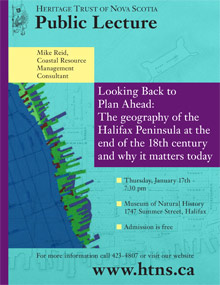
Looking Back to Plan Ahead: The geography of the Halifax Peninsula at the end of the 18th century and why it matters todayMike Reid is the Coordinator for the Coastal Research Network and a recent graduate of the Masters of Marine Management program at Dalhousie University. It has often been said that in order to properly prepare for the future, one must first understand the past. Join Mike Reid as he explains his use of historic maps to develop a picture of how the landscape of the Halifax Peninsula looked at the end of the eighteenth century. Mike will introduce some of the earliest detailed maps of the Halifax Peninsula as well as the cartographers who created them. He will then explore the advantages and pitfalls of using older cartographic data, and show how even two centuries later these historic images, combined with modern GIS technology can be used to inform modern planning and development strategies.
For more information call 423-4807 |
|||||
Past Events 2012 |
|||||
|
|||||
|
|||||
Thursday, September 20,
|
 Posted
  June 01-22



.jpg)
Thursday, January 19
Tom Urbaniak
(Political scientist, Cape Breton University)
“Toward a Heritage Charter for Nova Scotia: A Practical Policy Agenda”
Conserving heritage places is about much more than “registering” buildings and holding random protests. It’s about good tax policy and smart incentives. It’s about making sure public infrastructure money does more good than harm. It’s about coordinating heritage objectives with housing, economic development, public health, and other policies and programs. Political scientist Tom Urbaniak will propose a Heritage Charter; it will be an outline for a practical provincial omnibus bill to make it easier to identify, retain, and re-use our sites, districts, and cultural landscapes. The point is to safeguard Nova Scotia’s identity, generate good local jobs, give a boost to struggling communities, and transfer to future generations the tangible products of centuries of accumulated wisdom.
---
Tom Urbaniak, Ph.D., is a political scientist at Cape Breton University in Sydney. He was recently elected to represent Nova Scotia on the Board of Governors of the Heritage Canada Foundation. Part of his work has been at the intersection of heritage conservation, economic development, and housing. Tom’s books include Action, Accommodation, Accountability: Rules of Order for Canadian Organizations and Her Worship: Hazel McCallion and the Development of Mississauga. He is frequent media analyst on public affairs, giving interviews in English and French. Tom serves on the Cape Breton Regional Library Board and the board of Centre communautaire Etoile de l’Acadie. He is a member of the Canadian Polish Research Institute. One of the recent heritage projects for which he provided assistance and leadership is the revitalization of Sydney’s Polish Village Hall, owned by Canada’s oldest Polish community organization. Tom resides in the multicultural community of Whitney Pier, close to the site of the former Sydney steel plant.
Thursday, February 16
Laura DeBoer
(Urban archaeologist)
"A Tale of Two Buildings: The Archaeology of the Robertson Store and Albro's Brick Warehouse"
Both visitors and locals have come to know the Robertson Building on Lower Water Street
as a distinct piece of Halifax's shipping and ship building heritage thanks to its preservation
and the partial reconstruction of its displays as a part of the Maritime Museum of the
Atlantic. The structure is the result of a union of two separate buildings used for different,
but related, purposes. Beginning in the spring of 2011, an archaeological building survey
has been conducted in order to generate both a record of the building as it exists in the
present, and a reconstruction of the building's changes over time. This archaeological
approach provides focus on the material history of the building, its phases and styles, which
in turn delivers insight into those who have used and altered the building since its
construction.
Thursday, March 15
Royce Walker
(Chair, McNabs Island Advisory Committee)
What We Have Left Behind: Structures Built on McNabs Island
Late winter is the time to begin thinking about exploring McNabs Island and Royce Walker is our guide to the island lying off Eastern Passage. His topic is "What We Left Behind" and as you will see, this includes a variety of structures. Royce is a member-at-large of the McNabs and Lawlor Islands Provincial Park Advisory Committee and an enthusiastic guide to the hidden history of the island.
Among the indicators of past development are traces of the gardens developed by Frederick Perrin (of the Lea & Perrins Worcestershire Sauce family) on the estate where he summered. His gardens were said to rival Victorian gardens such as the Public Gardens in Halifax.
Lectures take place at the Museum of Natural History, Summer Street, at 7:30 pm. (see details at top of page)
Thursday, April 19
Claire Campbell
(Historian, Dalhousie University)
Reuse, Reinvent, Relocate: How Canadian Cities Manage their Historic Properties
Decisions, and controversies, about urban heritage tends to centre on individual buildings and specific projects: their location, their façade, their silhouette, and sometimes, their meaning. There is often little sense of their situation, especially their relationship to the natural environment in which they were placed. But this relationship is crucial to understanding both the site's historical significance and its reincarnated form and function.
This talk looks at how the downtown cores of Thunder Bay, Lunenburg, and Winnipeg were rearranged or recreated to accommodate popular ideas about Canada's history and nature on the one hand, and urban renewal and economic growth on the other.
Lectures take place at the Museum of Natural History, Summer Street, at 7:30 pm. (see details at top of page)
Thursday, May 17
Jeffrey Reed
(Heritage Consultant)
Over the last century the scope of value for heritage sites has moved from single architectural monuments of world importance to the intangible attributes of cultural landscapes. The speaker will examine this development and the implications for deepening and widening of what are now layered and complex understandings of the heritage we have received and which we may choose to protect and hand on to succeeding generations. Hearers will be challenged to consider the degree of cultural complexity which should be represented in the built and cultural environment, identified and protected in our communities: what pages are missing from the ongoing diary of peoples and places.
Lectures take place at the Museum of Natural History, Summer Street, at 7:30 pm. (see details at top of page)
Thursday, June 21, 2012 at 7:10 pm Annual General Meeting and at 8 PM Jim Bremner's talk about "J.F.W. DesBarres's Castle Frederick."
Located in Falmouth, Hants County, Castle Frederick has been the subject of a number of archaeological investigations over the past two decades and is considered to be an area of archaeological significance in Nova Scotia (including evidence of First Nations and pre- and post-Deportation Acadians). The site is best known for its association with J.F.W. DesBarres (1721-1824), soldier, cartographer-hydrographer, and colonial administrator who lived at Castle Frederick from 1764 until 1774. He controlled thousands of acres of land in Nova Scotia and New Brunswick. His estate included a large Manor House and an observatory, perhaps one of the first in North America, built in 1763. Equipped with some of the most advanced astronomical devices of the time, the observatory was important as a location for the calibration of his survey instruments and DesBarres used Castle Frederick as a base of operations for his famous series of coastal maps entitled the Atlantic Neptune. Jim Bremner is a direct descendant of DesBarres and owner of Castle Frederick Farms, located on part of what was once a much larger estate.
Lectures take place at the Museum of Natural History, Summer Street, at 7:30 pm. (see details at top of page)
Please note:
* The June lecture begins at 8 PM, following the Annual General Meeting at 7:10 pm.
2011
Thursday, October 20, 2011at 7:30 pm
"Nothing Happened Over There: Researching Prince's Lodge, Birch Cove and Rockingham."
Our second lecture of the season will be Sharon and Wayne Ingalls' illustrated talk "Nothing Happened Over There: Researching Prince's Lodge, Birch Cove and Rockingham." Sharon and Wayne recently published "Sweet Suburb", a local history that documents the many significant events that took place along the western shore of Bedford Basin. You will learn about the impact of duc d'Anville's fleet on the Mi'kmaq and on the founding of Halifax in 1749. The authors will also speak about a forgotten army camp at Birch Cove for British soldiers defeated in the American War for Independence. In addition, the stories and tales that have grown up around Prince's Lodge will be discussed.
Copies of the book will be available for $35 (cash or cheque).
2011 Winter Lecture Series
Thursday, January 20 at 7:30 pm
Paul Bennett ~ Endangered Schoolhouses: The "Palace Schools" of
Victorian and Edwardian Nova Scotia
Monday, February 21 at 7 pm*
Sara Beanlands ~ The Life and Legacy of the Rev. Dr. Andrew Brown
*Please note: This talk takes place at 7 pm at St. Matthew's United Church, Barrington Street.
Thursday, 17 March at 7:30 pm
Graeme Duffus ~ History of Masonry and Architecture:
Stirling, Cobb, and Duffus
Thursday, 21 April at 7:30 pm
Iris Shea ~ The Pool House in Jollimore:
Uncovering the Mystery of this 19th century house, its Original Location and Owners
Thursday, 19 May at 7:30 pm
Conrad Byers ~ The Role of Building Civic Pride through Buildings Thursday, 16 June at 7:10 pm
Annual General Meeting
(Lecture to follow at 8 pm)
Andrew Powter ~ An Illustrated Presentation on the Painted Rooms of
Nova Scotia
2010 Fall Lecture Series
Thursday, 16 September at 7:30 pm
Dr. Allan Marble ~ "Would you like to live in these Houses?"
Thursday, 21 October at 7:30 pm
Dr. Ian Cameron ~ "Lawlor's Island: the Quarantine Story"
Thursday, 18 November (Time and place TBA)
Annual Dinner
Speakers: Elizabeth and Philip Pacey ~
"Travels with Charley's Office: Keeping a Nova Scotia Landmark"
Thursday, 20 January, 2011 at 7:30 pm
Dr. Paul Bennett ~ "Palace Schoolhouses in Nova Scotia"
Special Lecture and Performance
Saturday, September 11 at 7:30 pm St. John's Anglican Church, Lunenburg
Tickets $15 ($5 students at the door).
A Celebration of Music in Historic Churches
Gordon Callon, Adjunct Professor of
History and Musicology at Acadia University
will lecture on
English Theatre Songs from Robert Johnson to Henry Purcell followed by
music by Byrd, Johnson, Wilson, Wm Lawes, Purcell, and Draghi
17 June, 2010. 8:00 PM (FOLLOWING the AGM which begins at 7:10 PM)
Speaker: Marilyn Gurney
Topic: "The King's Yard"
20 May, 2010, 7:30 PM
Speaker: Brian Robinson
Topic: "History of Fortified Towns - Halifax's Fortified Heritage"
15 April, 2010, 7:30 PM
Speaker: Garry Shutlak
Topic: David Stirling's Houses
18 March, 2010
Speaker: Father Maurice LeBlanc
Topic: "Acadian Painting in Acadie"
Fr. LeBlanc will discuss the evolution of painting by Acadians, beginning at the end of the 19th century, up to the establishment of a Department of Fine Arts at l‚Université de Moncton in 1963. Father LeBlanc is a graduate of l‚Université Sainte-Anne and Gregorian University, Rome. A retired professor of Art History and Artistic Director, he lives in West Pubnico, where he enjoys painting and choral music. The talk is one in a series of free public lectures held by Heritage Trust of NS. Everyone is welcome.
18 February, 2010
Speaker: Arthur Irwin
Topic: "A Chapel with a Wonderful Personality"
St. Margaret's Anglican Church in Laurie Park
Energy Consultant and CBC Radio Noon expert Arthur Irwin will speak about St. Margaret's Church in Oakfield at the Nova Scotia Museum on Summer Street at 7:30 p.m. on Thursday, Feb. 18.
St. Margaret's of Scotland Church was built by an Englishman, Lieutenant General John Wimburn Laurie. He arrived in Canada in 1861. In 1865 he purchased 800 acres in Oakfield and established one of our earliest communities. He brought twenty families from England. This beautiful structure was built from the pine logs on the estate for the family and servants, modelled after the Old English tradition. The chapel was one of the first buildings to be erected which was followed by a school, post office, stable, sawmill, stage coach inn, railway siding and two quarries. Three generations of Lauries are buried behind the Chapel.
In October, 1999, Arthur Irwin was asked by the Anglican Diocese of Nova Scotia, to assist in the planning process to make the building more energy efficient. Mr. Irwin has dealt with several hundred historic structures throughout his career but this example of a wonderful "Historic Gem" had a special significance and presented a number of interesting challenges as he upgraded the energy efficiency of this unique structure.
The original oil lamps are still hanging from the high ceilings, a leather bound bible on the lectern inscribed "Oakfield Church 1868". A beautiful stained glass window behind the Altar remains intact.
"Simplicity, warmth and a quiet elegance produced from the surrounding stately pines caught my attention," says Mr. Irwin. "I visualized an imaginary sign stating, 'Do not disturb' hung across the dark stained interior wainscoting which reminded me to prevent any signs of man made footprints."
All of the exterior walls have been upgraded, insulated, windows replaced and a new heating system installed. The "Chapel In The Pines" will hopefully stand for another 130 years, respecting our forefathers contribution to our heritage !
The meeting is open to the public, free of charge and is sponsored by the Heritage Trust of Nova Scotia. Light refreshments will be served.
Presentation of Heritage Trust of Nova Scotia Built Heritage Awards
Date: February 15, 2010
Time: 3:00 – 5:00 PM (Presentations begin – 3:30 pm, Reception to follow)
Location : Halifax City Hall (Halifax Hall) Argyle St. Halifax ...more
21 January, 2010
Speaker: Peter McGuigan talk about "The early history of St. Mary's University (1802-1952)"
at 7:30 p.m. on Thursday, January 21, in the auditorium of the Nova
Scotia Museum, 1747 Summer Street, in Halifax.
The evening is sponsored by the
Heritage Trust of Nova Scotia.
The public are invited to attend.
Past Events 2009
Thursday, June 18th, 2009
Annual General Meeting at 7:10 pm
Guest Speaker: Jonathon Fowler
Interpreting Acadian Houses in the Pre-Deportation Period
Thursday, May 21st, 2009
Struggle to Open, Struggle to Survive: St. Mary's College 1802-1952)
Peter McGuigan
Workshops
TBA
Walking Tours
TBA
Open Houses
TBA